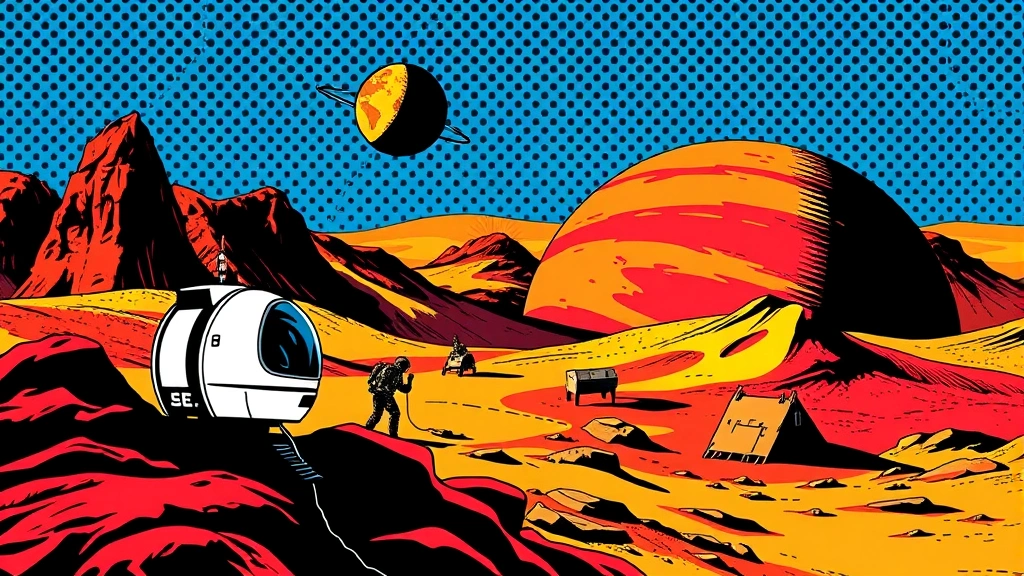
Harry Margulies explores whether Mars colonisation could become a one-way trip as settlers adapt to the Red Planet's low gravity, and what that means for the future of human spaceflight.
When we talk about sending humans to Mars, the conversation usually revolves around rockets, fuel, and the sheer distance involved. But there's a quieter, more insidious challenge that rarely makes the headlines: gravity. Or, more precisely, the lack of it. Harry Margulies takes a hard look at whether Mars colonization might quietly become a one-way trip, not because of a lack of ambition, but because our bodies may simply adapt to the Red Planet in ways that make returning to Earth impossible.
### The Invisible Anchor We Take for Granted
Here on Earth, we never think about gravity. It's just there, holding our coffee cups down and keeping our bones dense. But on Mars, the story is completely different. The Red Planet's gravity is only about 38% of what we experience on Earth. That might sound like a fun, bouncy way to live, but for the human body, it's a slow-motion crisis.
Your bones and muscles are built for a 1G environment. When you drop to 0.38G, your body starts to think it doesn't need all that mass anymore. Over months and years, bone density decreases, muscle mass atrophies, and your cardiovascular system gets lazy. It's the same problem astronauts face on the International Space Station, just stretched out over a much longer timeline.
### The One-Way Ticket Scenario
Here's where the conversation gets uncomfortable. If a settler spends five or ten years on Mars, their body will have fundamentally changed. Their bones will be weaker, their muscles smaller, and their sense of balance completely recalibrated. Now imagine that same person trying to come back to Earth. The sudden return to full gravity would feel like having a pickup truck parked on your chest.
It's not just about feeling heavy. It's about the risk of fractures, the strain on the heart, and the potential for permanent disability. Some experts argue that a long-term Martian resident would simply be unable to survive the return trip. Not because of the rocket, but because of the physics of their own body.
### What This Means for the Mission
This reality forces us to ask some tough questions about the future of space exploration. Are we planning a colony, or are we planning an exile?
- If the goal is permanent settlement, then a one-way trip might be perfectly acceptable. The settlers know they're staying, and their bodies adapt to Mars as their new normal.
- If the goal is scientific exchange and rotation, then we need to figure out how to keep astronauts fit enough to come home. That might mean artificial gravity on the spacecraft, or strict exercise regimens that mimic Earth's load.
- If the goal is human expansion, then we have to accept that the first generations of Martians will never see Earth. Their children, however, might be born with a completely different physiology, one that's actually suited for the Red Planet.
### The Ethical Question We Can't Ignore
There's also a moral dimension to this that we can't sweep under the rug. If we send people to Mars knowing they can't come back, are we being honest with them? The early explorers who crossed the oceans knew they might not return, but they signed up for that risk. The question is whether our modern space agencies and private companies are being equally transparent with their crews.
Some would argue that the adventure itself is worth the sacrifice. That the chance to be the first human to set foot on another world outweighs the certainty of never coming home. And honestly, that's a deeply personal decision. But it should be a decision made with full knowledge of the consequences, not a pleasant lie told to get a crew to sign on the dotted line.
### The Road Ahead
As we stand on the brink of this new era, it's clear that Mars is more than just a destination. It's a test of our endurance, our engineering, and our ethics. The technology to get there is almost within our grasp. The biology of staying there is a problem we're only beginning to understand.
Whether Mars becomes humanity's greatest adventure or a quiet, permanent exile depends on the choices we make right now. We need to invest in research on low-gravity living, develop countermeasures that keep our bodies strong, and have honest conversations about what we're asking our astronauts to give up. Because the reality is, the first Martians might not be pioneers. They might be the first people to truly leave Earth behind, not as a triumph, but as a necessity.