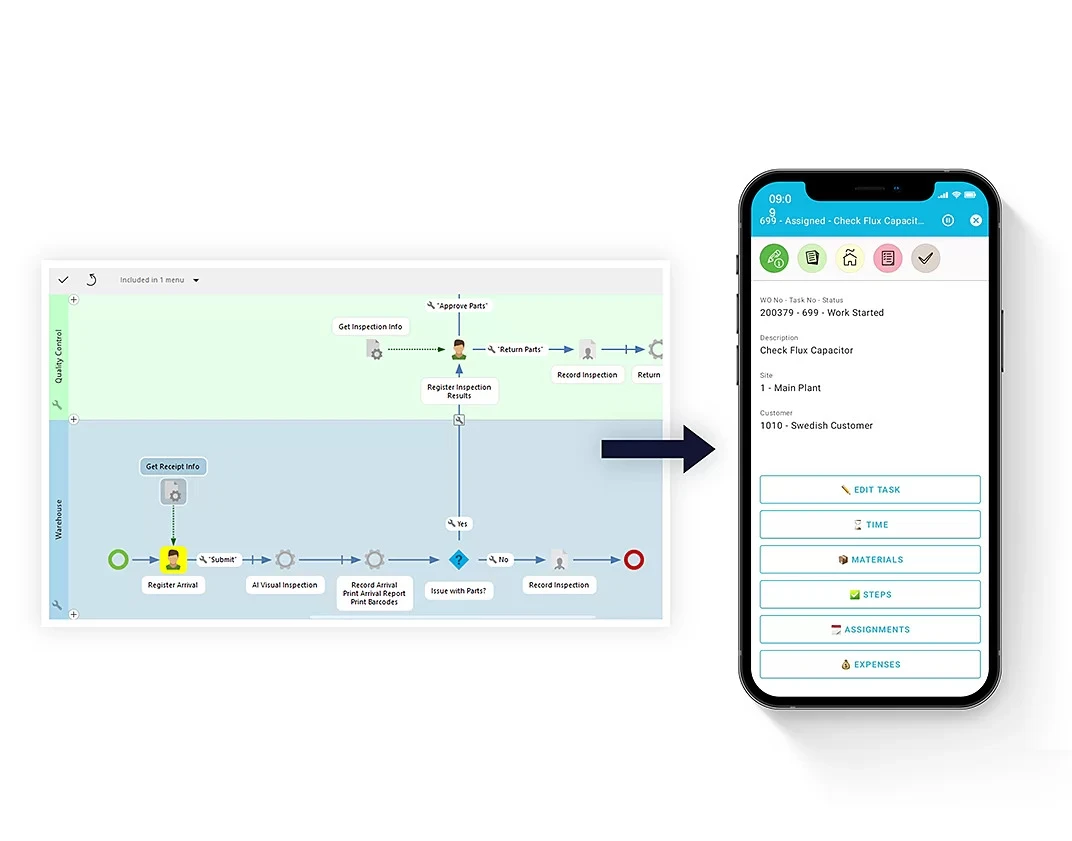
Your ERP, WMS, and CRM all work well alone. So why does your team still waste time copying data and chasing approvals? The real productivity problem hides in the gaps between your business systems.
You know that feeling, right? Your company has invested heavily in all the right systems—ERP for orders and inventory, WMS for the warehouse, MES for production, and CRM for customers. Each one does its specific job well. Yet, somehow, your team still seems to spend half their day copying numbers, sending emails for approvals, and wrestling with spreadsheets to fill the gaps.
Here's the uncomfortable truth. The biggest productivity drain isn't inside any single application anymore. It's hiding in the awkward hand-offs *between* them. Your organization is digital, but your workflows are still painfully fragmented.
### When Good Tools Create Bad Processes
Think about a typical process, like fulfilling an order. It might start in the ERP, move to the warehouse system for picking, bounce over to a quality check app, then need a transport management update, and finally require a customer notification. An employee is constantly switching contexts, copying data, and manually nudging the next person in line.
It looks like this:
- Data gets re-entered, inviting errors.
- A critical approval sits forgotten in an inbox.
- The warehouse acts on info that hasn't updated in the ERP yet.
- Another team waits on a confirmation that was already logged somewhere else.
Nothing is "broken," but the process demands way more human effort than it should.
### The Hidden Tax of Tiny Tasks
We overlook these inefficiencies because each one seems so small. Copying a reference number takes less than a minute. Sending an approval email takes a few more. Switching screens to check a status feels normal.
But multiply those tiny tasks by hundreds of transactions a day, across multiple departments. The cost adds up—not just in time, but in mental fatigue and operational risk. It's a hidden friction that a standard system review will almost never catch.
### Why Simply Connecting Systems Isn't Enough
The obvious fix is integration, and modern APIs do make sharing data easier. But there's a crucial difference between *system* integration and *workflow* integration.
You can have two applications talking perfectly, yet employees still have to figure out what to do next. As one operations manager put it, "The data moved. The process did not."
A true connected workflow has to account for people, business rules, and exceptions. It needs to answer: Who acts now? What do they need to see? How is the next step triggered? What happens when things go off-script?
This is why **process orchestration** is becoming the next big focus. The real challenge isn't getting systems to communicate; it's getting *work* to flow smoothly across them.
### From Connected Software to Connected Work
So, what's the solution? One promising approach is to leave your core transactional systems—your ERP, WMS, MES—right where they are, doing what they do best. Then, wrap a flexible, intelligent workflow layer around them all.
Think of it as building a new, efficient highway system that connects all your existing towns (your software systems). The towns stay put, but traffic flows seamlessly.
This layer handles the routing, the notifications, the approvals, and the exception handling. It ensures the right person gets the right information at the right time, automatically moving the work forward. Your ERP remains the single source of truth for core data. Your specialist apps keep doing their specialized jobs. But the manual glue in between—the emails, the spreadsheets, the endless switching—finally disappears.
The goal shifts from merely having connected systems to enabling truly connected work. And that's where the next wave of real productivity gains is waiting to be unlocked.