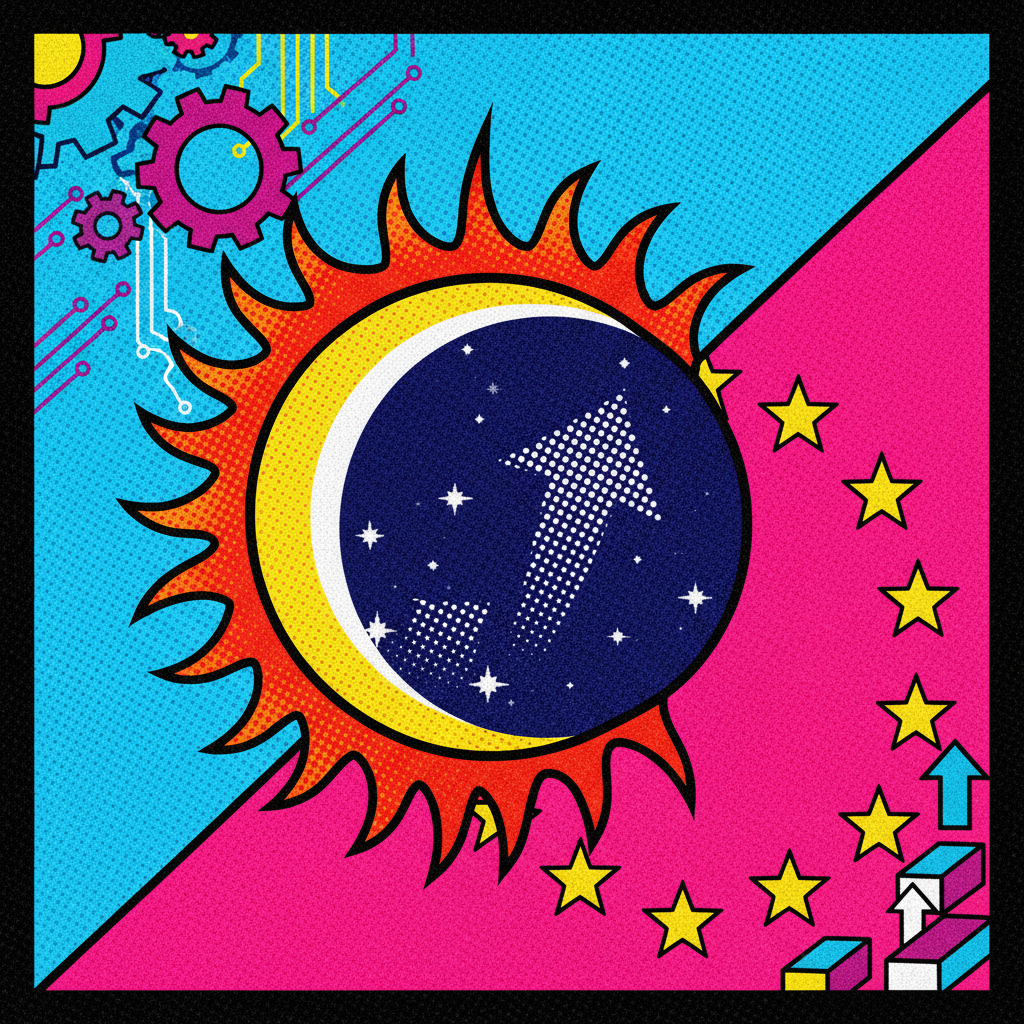
ESA's Proba-3 mission uses two satellites to create artificial solar eclipses, giving scientists hours of continuous corona observation to improve space weather forecasting.
Solar eclipses are rare, dramatic, and over in minutes. When the Moon slides perfectly between Earth and the Sun, the sky darkens, temperatures drop, and for a brief moment, the Sun's ghostly corona flares into view. But here's the thing: that fleeting corona is exactly what scientists need to study, and they only get a few precious minutes every couple of years to do it. So what if they didn't have to wait?
That's the idea behind a bold new mission from the European Space Agency (ESA). Using two satellites flying in precise formation, they're creating artificial solar eclipses on demand. It sounds like science fiction, but it's very real, and it could change how we forecast space weather in ways that matter to all of us back on Earth.
## The Problem With Real Eclipses
A total solar eclipse is a spectacular sight, but for researchers, it's a frustratingly short window. The corona, the Sun's outer atmosphere, is a million times fainter than the Sun itself. You can't just point a telescope at it during the day; the Sun's blinding light washes everything out. During a natural eclipse, the Moon acts as a perfect shield, blocking the disk and revealing the corona. But that shield only lasts for a few minutes, and it only happens over a narrow path on Earth.
That means scientists get a tiny glimpse of the corona every so often, and then they're back to waiting. It's like trying to understand a hurricane by looking at it through a keyhole for five seconds every two years. You get some clues, but you miss the bigger picture.
## The ESA Solution: Make Your Own Eclipse
The European Space Agency decided to stop waiting for nature to cooperate. Their mission, called Proba-3, uses two satellites working as a team. One satellite acts as the "occulting" spacecraft, positioning itself to block the Sun's disk from the other satellite's view. The second satellite, the "coronagraph," then captures detailed images of the corona.
The trick is the precision. These two satellites are flying about 500 feet apart, and they have to hold their positions within a fraction of an inch. Imagine two cars driving at 60 miles per hour, 500 feet apart, keeping a laser pointer perfectly aligned between them for six hours straight. That's the level of control we're talking about.
When it works, the mission creates an artificial eclipse that lasts for hours, not minutes. That gives researchers an unprecedented, continuous view of the corona. And this isn't just about pretty pictures. The corona is where solar wind originates, and it's the source of solar storms that can disrupt satellites, power grids, and GPS systems here on Earth.
## Why This Matters for You
You might be thinking, "Okay, cool space stuff, but what does this have to do with my day?" Well, more than you'd think. Space weather is a real phenomenon, and it has real consequences. A powerful solar storm can knock out communication networks, mess with your phone's GPS, and even cause blackouts. Back in 1989, a solar storm caused a massive power outage in Quebec, leaving millions without electricity for hours.
By studying the corona in detail, scientists can better predict when these storms might hit. The goal is to give us an early warning system, a few days' heads-up instead of a few hours. That kind of forecast could let utility companies protect their grids, airlines reroute flights, and satellite operators put their spacecraft in safe mode.
## The Road Ahead
The Proba-3 mission is a stepping stone. The data it collects will help refine models of the Sun's behavior and improve our ability to forecast space weather. It's a long game, but every artificial eclipse brings us closer to understanding our star.
So, the next time you see headlines about a solar eclipse, remember that the real action isn't just the few minutes of darkness. It's the hours of data that missions like Proba-3 are designed to capture. We're not just watching the Sun anymore; we're learning to predict its moods. And that's a skill we're all going to need.