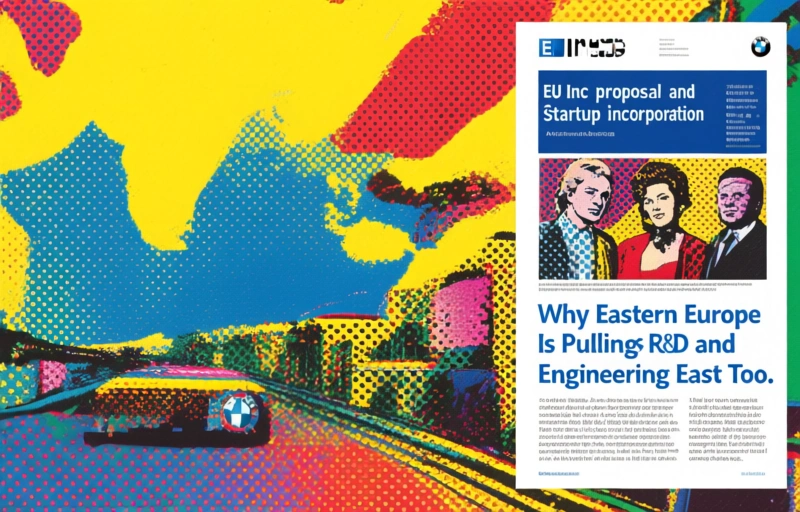
Western European companies are moving manufacturing east, and now R&D and engineering are following. BMW and Bosch lead the shift as quality catches up and the split model becomes unsustainable.
### The Manufacturing Shift Is Already Underway
Over the past few years, more and more Western European companies have started moving real production east. Not outsourcing, not subcontracting—they're physically relocating assembly lines, factories, and entire manufacturing capacity to countries in Eastern Europe. What used to be small pilot projects has turned into a stable operational model for many industries.
**Take BMW, for example.** The BMW Group is setting up a massive, full-scale vehicle plant in Hungary. It's a cornerstone for their upcoming electric vehicle lineup. The facility opened in late 2025 and is their most innovative site yet—designed to run entirely without fossil fuels. Meanwhile, back in Germany, they're actually reducing production lines.
**Bosch is doing something similar.** They're restructuring their global production network in a big way. That means cutting back on manufacturing in Germany while expanding operations in Poland. It's a clear sign that the center of gravity is shifting.
So why are they doing this? The reasons are mostly practical. Regulatory pressure in Western Europe keeps growing. Administrative procedures get heavier every year. Even simple changes in production can require long approval cycles. In Eastern Europe, it's a different story: fewer formal barriers, lower operational costs, and a more flexible attitude toward industrial development. For many companies, the balance between cost, quality, and speed simply works better there.
### Quality Isn't the Issue Anymore
A decade ago, quality was a big concern when moving production east. Not anymore. The technical level of suppliers, operators, and local infrastructure has grown significantly. In many cases, companies manage to keep the same standards while gaining more freedom in how production is organized and scaled. This combination—similar quality with less friction—is what really drives the shift.
### What Still Remains in the West
Even though production has moved east, most of the "brain" of these companies is still firmly in Western Europe. Brands keep their headquarters in their home countries. Research and development centers, engineering teams, and product design departments continue to operate near corporate offices. These functions are tied to the networks, universities, and ecosystems that originally built the company's technical advantage.
This creates a split model that many companies are living with today. Production takes place hundreds—sometimes even a thousand miles—away, while engineers and design teams stay in the West. Messages, reports, and video calls try to bridge the gap, but it's not the same as being on the factory floor.
- Decisions get delayed.
- Small problems turn into bigger ones.
- Solving them takes longer than if the teams were in the same place.
For now, companies manage with this setup, but the strain between where things are built and where they're designed is becoming harder to ignore.
### Why This Model Isn't Sustainable
When engineering teams are hundreds of miles away from production, problems appear that no report or video call can catch. Even if a component meets all specifications, it can still cause headaches during assembly. Workers sometimes create unofficial solutions on the spot, and engineers only notice weeks later—which pushes timelines back.
The separation also makes quick improvements almost impossible. If a design change is needed, engineers have to wait for feedback. Production has to pause or adapt without full guidance. Costs go up, timelines stretch, and sometimes mistakes get repeated simply because no one can see the situation in real life.
> "Being physically close to the manufacturing process allows engineers to test, adjust, and refine in real time, which is essential for complex products."
Being far from the factory means that little problems build up over time, and solving them takes much longer. It's like trying to fix a leaky pipe from a different building—you can guess what's wrong, but you can't actually see the water dripping.
### What This Means for the Future
So here's the bottom line: as more manufacturing moves east, it's only a matter of time before the engineering and R&D follow. Companies will realize that the split model costs more in the long run than just moving the whole operation. We're already seeing hints of this trend, with some firms opening small engineering offices near their new factories. It won't be long before the "brain" catches up with the "brawn."