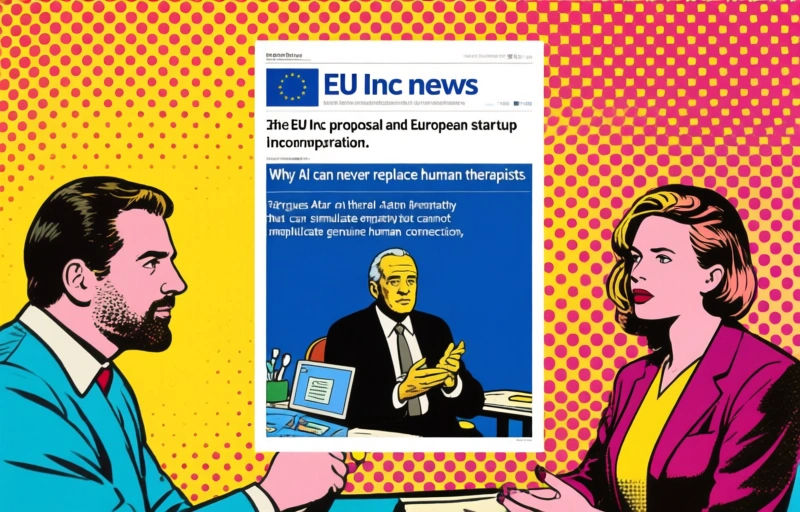
Professor Michael Atar argues that AI therapy can simulate empathy but cannot replicate genuine human connection, highlighting the limits of technology in mental health care.
Professor Michael Atar argues that AI therapy can simulate empathy but cannot replicate genuine human connection. This is a bold claim in an era where technology is advancing faster than ever, but it's one that resonates deeply with anyone who's ever sat across from a therapist and felt truly heard.
### The limits of simulated empathy
AI can mimic empathy by analyzing patterns in your words and tone. It can respond with phrases like "That sounds tough" or "I understand how you feel." But here's the thing: it doesn't actually feel anything. It's like a parrot that learns to say "I love you" without understanding what love means. For therapy to work, clients need to believe their therapist genuinely cares. With AI, you're always aware there's no real person on the other end. That awareness can create a barrier that no amount of clever programming can break through.
- AI lacks genuine emotional experience
- It can't form a real therapeutic alliance
- Trust is harder to build without a human presence
### What human connection brings to therapy
When you talk to a human therapist, you're engaging in a relationship that's built on mutual trust and vulnerability. Your therapist notices your body language, hears the catch in your voice, and picks up on the things you don't say. These subtle cues matter. They help the therapist tailor their approach to your unique needs. AI, no matter how sophisticated, can't read the room the same way. It can't sense when you're holding back tears or when you need a moment of silence. Those moments are where real healing often happens.
### The risk of over-reliance on AI therapy
There's a growing push to make therapy more accessible through AI. And sure, it's cheaper and available 24/7. But if we lean too hard on these tools, we risk losing the very thing that makes therapy effective: human connection. A machine can't offer you a tissue when you're crying. It can't share a knowing smile when you finally have a breakthrough. These small gestures might seem insignificant, but they're the building blocks of trust.
### Why AI is a tool, not a replacement
Professor Atar isn't saying AI has no place in mental health. It can be useful for triage, symptom tracking, or providing basic coping strategies. But as a replacement for a human therapist? That's where he draws the line. Think of AI like a calculator. It can help you do math faster, but it can't teach you the beauty of a mathematical proof. Similarly, AI can offer support, but it can't offer the depth of a genuine human relationship.
### The bottom line
At the end of the day, therapy is about connection. It's about feeling seen, heard, and understood by another person. AI can simulate parts of that experience, but it can't replicate the real thing. For anyone struggling with their mental health, the best option is still a qualified human therapist who can offer empathy that's more than just clever code.