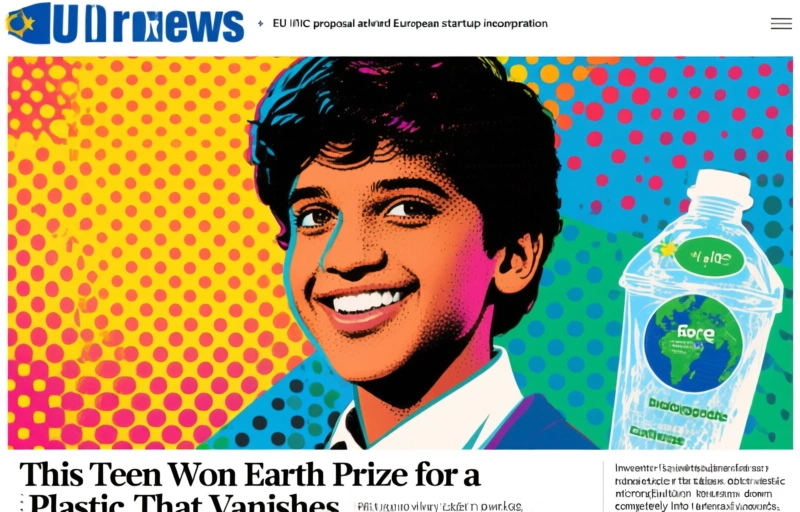
Teen inventor Arya Satheesh wins the Earth Prize for Eco Purge, a biodegradable plastic that tackles microplastic pollution by breaking down completely into harmless compounds.
You've probably heard the stats about microplastics by now. They're everywhere—in the ocean, in the air, and even inside our bodies. But here's the thing: most solutions focus on cleaning up what's already out there. What if we could stop the problem before it starts?
That's exactly what 17-year-old Arya Satheesh set out to do. And she just won the Earth Prize for it.
### The Big Idea: Eco Purge
Arya created something called Eco Purge. It's a biodegradable plastic that breaks down naturally, leaving no microplastic behind. Think of it like a paper bag that dissolves in water—but way more durable and practical.
Traditional plastics can take hundreds of years to decompose. And when they do, they just turn into smaller and smaller pieces. Those tiny fragments, called microplastics, are now a global crisis. They've been found in human blood, in the deepest ocean trenches, and in Arctic ice. Eco Purge flips the script: instead of lingering forever, it degrades into harmless compounds.
### How It Works (Without the Jargon)
Here's the simple version. Most plastics are made from long chains of molecules that nature doesn't know how to break down. Arya found a way to weave in a special trigger—a natural enzyme—that kicks in under certain conditions, like heat or moisture. When the plastic's job is done, the enzyme activates and the whole thing falls apart into basic, non-toxic components.
- **No microplastic residue** – The breakdown is complete, not partial.
- **Safe for the environment** – The byproducts are just CO2 and water.
- **Cost-effective** – Arya designed it to be affordable enough for mass production.
### From Classroom to Global Stage
Arya isn't a professional scientist. She's a high school student from Kerala, India, who started tinkering in her school lab. Her project caught the attention of the Earth Prize, a $100,000 award for young environmental innovators. She won the 2025 edition, beating thousands of other teens from around the world.
The prize money isn't just a pat on the back. She's using it to patent Eco Purge and scale up production. Her goal? Partner with manufacturers who want to replace conventional plastics in packaging, single-use items, and more.
### Why This Matters Right Now
Microplastic pollution isn't a future problem—it's a current one. Scientists estimate that we ingest about five grams of plastic every week. That's the weight of a credit card. And the damage isn't fully understood yet, but early studies link microplastics to inflammation, hormone disruption, and other health issues.
Most cleanup efforts focus on removing plastic from the ocean. But that's like mopping the floor while the faucet is still running. Arya's approach tackles the source: create plastics that don't pollute in the first place.
> "We don't need to invent a completely new material," Arya said in a recent interview. "We just need to make the ones we already use smarter."
### The Real Challenge Ahead
Of course, a lab breakthrough doesn't automatically change the world. There are hurdles:
- **Manufacturing scale** – Can Eco Purge be produced cheaply enough for companies to adopt it?
- **Durability** – Biodegradable plastics sometimes break down too quickly for certain uses.
- **Consumer behavior** – People need to trust that these new materials work as well as traditional plastic.
Arya is already working on these issues. She's collaborating with material scientists to fine-tune the formula. And she's optimistic that Eco Purge can hit the market within two years.
### What This Means for You
You might be thinking: "I'm not a teen inventor. What can I do?"
Fair point. But Arya's story isn't just about one kid's genius. It's about a shift in how we think about waste. Instead of accepting plastic as a necessary evil, we can demand better. Support companies that invest in biodegradable alternatives. Push for policies that reward innovation over cheap, polluting materials.
And if you're an entrepreneur or investor? This is a space worth watching. The global bioplastics market is expected to hit $30 billion by 2030. The first person to crack the code on affordable, truly biodegradable plastic will change the world—and make a fortune.
### The Bottom Line
Arya Satheesh didn't wait for someone else to solve the microplastic crisis. She rolled up her sleeves and built a solution in her school lab. Eco Purge isn't perfect yet, but it's a massive step forward. And it proves that age, resources, and location don't limit what you can achieve.
Next time you unwrap a package, think about where that plastic ends up. Then think about what happens when a material is designed to disappear. That's the future Arya is building—one biodegradable molecule at a time.
The post Meet the Earth Prize-winning teenager tackling the world's microplastic crisis appeared first on The European Magazine.