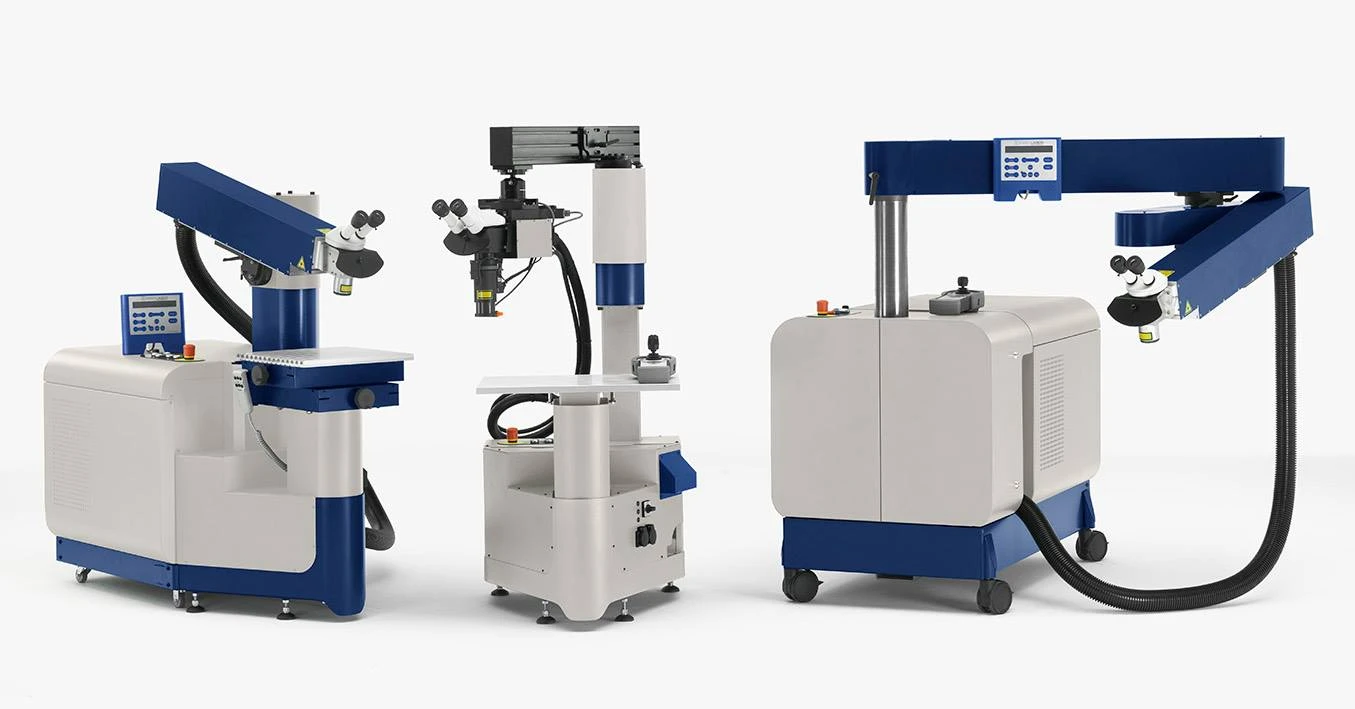
Sigma Laser, a German manufacturer founded in 2005, builds laser welding machines for precision repairs in tooling, medical, and aerospace industries. Their six mobile and stationary systems serve over 25 countries.
Sigma Laser is a German laser welding machine manufacturer based in Hanau and founded in 2005. Its six mobile and stationary systems use Nd:YAG and fiber laser sources with five-axis positioning, serving tool and mold makers, medical device, aerospace, and electronics manufacturers in more than 25 countries.
### Company Facts
- **Founded:** 2005
- **Headquarters:** Hanau, Germany
- **Product Range:** Six 5-axis open-frame laser welding systems: mobile (Sineo Light, Sineo Fibre, Sirius Light) and stationary (Sidanus Light, Sidanus Fibre, Siega Fibre); no workpiece size or weight limit
- **Beam Sources:** Pulsed Nd:YAG (1064 nm, Light series) and ytterbium fiber laser (1070 nm, Fibre series)
- **Technology:** Super Pulse Technology (SPT), Sigomatic / Sigomatic Pro control software, remote diagnosis software
- **Recognition:** German Design Award 2025 for the Sineo system
- **Customers:** Manufacturers and suppliers in more than 25 countries. Reference customers include Airbus, Siemens, and Continental
### The Problem: Heat, Distortion, and Slow Outsourcing
Precision parts fail for simple reasons: wear on a sealing edge, a chipped cavity, a cracked parting line. Conventional TIG can fix some of it, but heat-affected zones and distortion threaten tolerances. On tool steels, titanium, and nickel-based alloys, the risk of softening or warping rises. Finishing time grows and scrap mounts.
Outsourcing a repair adds delay: the mold leaves the plant, and transport, queue time, and paperwork follow while a press stands idle. The cost is not only the invoice but lost output and missed deliveries. For medical devices, re-making a validated mold can trigger new qualification steps; in aerospace, rework on jigs and fixtures needs traceability.
### Laser Welding: A Repair-First Route
Laser welding offers a repair-first route. It adds material only where needed, with controlled, localized heat: the seam is narrow, the heat-affected zone is small, and polishing and regrinding are shorter. For a plant manager, that means bringing a tool back to specification without a strip-down or a costly remake; for procurement, fewer replacements and approved tooling kept in service longer.
Results must also be consistent across shifts and sites. Documented parameters and stable pulse behavior make a repair repeatable rather than operator-dependent. This is the space Sigma Laser targets: in-house, documented, low-distortion repairs and modifications on demanding materials.
### Product Philosophy: Mobile or Stationary, Configured Around the Process
Sigma Laser's approach is to fit the machine to the task, not the other way around. The six systems share an open, five-axis architecture (X·Y·Z·C·D) that brings the optics to the seam at the required angle. That choice matters when the part is heavy, installed, or simply faster to access on the line.
Mobile systems – Sineo Light, Sineo Fibre, and Sirius Light – are open, wheeled workstations that come to the part. Maintenance teams roll them to a press, a die cart, or a bench; the open frame imposes no workpiece size or weight limit, which removes lifting, trucking, and re-rigging from the critical path.
Stationary systems – Sidanus Light, Sidanus Fibre, and Siega Fibre – are built for workshops that value repeatability at a fixed station. Toolrooms use them for planned repairs, geometry additions, and small-series work under fixtures, with saved programs supporting predictable, documented outcomes.
When a process needs series automation, the Simass modules extend the concept. The Base Unit, Slide, and Rotate modules add flexible motion and part handling for repetitive tasks. Manufacturers can configure these modules to suit their specific production needs, creating a tailored solution that grows with their business.
> "The right tool for the job isn't always the biggest—it's the one that fits your workflow."
In a world where every minute of downtime counts, having the ability to repair precision parts in-house with minimal distortion is a game-changer. Sigma Laser's machines are designed to do exactly that, quietly and efficiently.