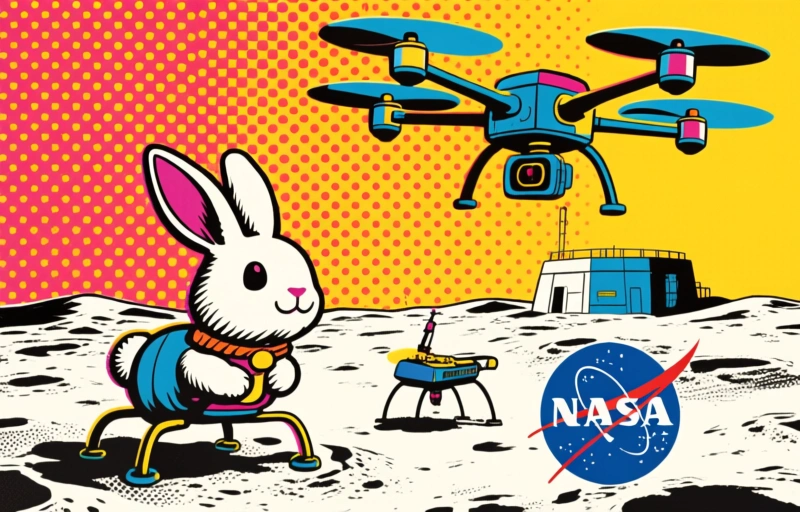
NASA's MoonFall project will send rabbit-like hopping drones to the lunar South Pole to scout sites for a future Moon base, paving the way for sustainable human exploration.
NASA is taking a big leap forward in space exploration, and it's got a new, unexpected helper: a rabbit-like drone. The space agency's MoonFall project will send these hopping drones to the lunar South Pole, a region that's key to future plans for a permanent Moon base.
### Why the South Pole Matters
The Moon's South Pole isn't just any spot. It's a place where scientists believe there's water ice in shadowed craters. That ice could be turned into drinking water, breathable oxygen, and even rocket fuel. So, before we send humans there, we need to know exactly what we're dealing with.
NASA's MoonFall drones are designed to hop across the rugged terrain, covering ground that rovers can't. They'll scout for the best places to set up a base, map out resources, and test the environment. Think of them as scouts on a mission to pave the way for a lunar settlement.

### How the Drones Work
These aren't your typical drones. They're built to hop, not fly, which makes them perfect for the Moon's low gravity. Each drone can leap distances of up to 1,000 feet (about 305 meters) and reach heights of 100 feet (30 meters). They use sensors and cameras to navigate and send data back to Earth.
- **Hopping mechanism**: Uses legs like a rabbit to push off the surface.
- **Payload**: Carries instruments to measure temperature, radiation, and soil composition.
- **Autonomy**: Navigates on its own, avoiding rocks and craters.
This design is efficient and tough. It can handle the Moon's extreme temperatures, which swing from -280°F (-173°C) at night to 260°F (127°C) during the day.
### Why This Matters for Space Exploration
The Moon is a stepping stone for deeper space missions. If we can build a base there, we can test technologies for Mars and beyond. The lunar South Pole is a prime location because it gets near-constant sunlight for solar power and has access to ice.
NASA's Artemis program plans to land astronauts on the Moon by 2025, and the MoonFall drones will help pick the landing sites. They'll also look for hazards like sharp rocks or deep dust that could mess up a landing.
### What's Next for the Project
The MoonFall drones are still in development, but NASA's already testing prototypes on Earth. They're using a special facility that simulates lunar gravity and terrain. If all goes well, the drones could launch on a future mission within the next few years.
There's also talk about using these drones for other planets. Mars has low gravity too, and hopping drones could explore places rovers can't reach. But for now, the focus is on the Moon.
> "The Moon is the proving ground for everything we want to do in space," says a NASA engineer working on the project. "These drones are a small but critical part of that vision."
### Challenges Ahead
Building a Moon base isn't easy. There's radiation, dust that's like tiny glass shards, and the constant risk of meteoroids. The drones need to be tough enough to survive all that. Plus, they have to communicate with Earth, which means a 2.5-second delay for signals.
But NASA's confident. The MoonFall project is part of a larger push to make space exploration more sustainable. Instead of sending everything from Earth, we can use local resources. That's called in-situ resource utilization, and it's a game changer.
### Final Thoughts
The idea of rabbit-like drones hopping around the Moon might sound a bit silly, but it's actually brilliant. It's a perfect example of how we can use nature's designs to solve tough problems. And it shows that even the most ambitious goals start with small, clever steps.
So, keep an eye on the Moon. Those little drones could be the first to make a big difference.