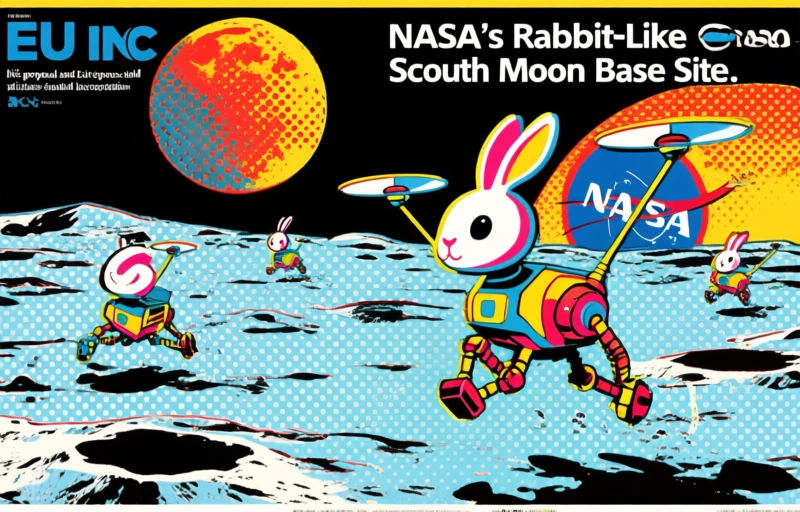
NASA's MoonFall drones will hop across the lunar South Pole like rabbits, scouting for the best site to build the first Moon base. These agile robots can leap up to 2 miles, mapping treacherous terrain and searching for water ice.
NASA is taking a fresh approach to lunar exploration with its MoonFall drones—hopping robots designed to bounce across the lunar South Pole like rabbits. These aren't your typical rovers. Instead of rolling on wheels, they'll leap over rough terrain, scouting for the perfect spot to build the first Moon base. It's a bold move that could reshape how we think about space exploration.
### Why the Moon South Pole?
The lunar South Pole is a prime target for future missions. It's home to permanently shadowed craters that might hold water ice—a critical resource for drinking, fuel, and oxygen. But the terrain is treacherous, with steep slopes, sharp rocks, and deep pits. Traditional rovers struggle there, so NASA needed something more agile. Enter the MoonFall drones.
These drones can hop up to 2 miles in a single bound, covering more ground than a wheeled rover in less time. They're lightweight, about 20 pounds each, and equipped with cameras and sensors to map the surface. Think of them as scouts for the astronauts who'll follow.

### How the Drones Work
Each drone uses a small rocket engine to launch itself into the air. It can adjust its trajectory mid-flight to avoid obstacles, then land softly on spring-loaded legs. The hopping motion mimics a rabbit's, which is why NASA calls them "rabbit-like." They'll operate in pairs, communicating with each other and with a base station back on Earth.
- **Range:** Up to 2 miles per hop
- **Weight:** Around 20 pounds
- **Power:** Solar panels and batteries
- **Payload:** High-res cameras, spectrometers, and a drill
This setup lets them explore areas that are hard to reach otherwise. For example, they can peer into shadowed craters without getting stuck or damaging equipment.

### What This Means for Moon Base Plans
Building a permanent Moon base is a huge undertaking. You need to know where to put it—somewhere flat, stable, and close to resources like water ice. The MoonFall drones will map the South Pole in detail, creating 3D models of potential sites. They'll also test the soil's composition and look for signs of subsurface ice.
"This is a game-changer," says Dr. Elena Rossi, a NASA planetary scientist. "We can't send astronauts into unknown territory blind. These drones give us the intel we need to make smart decisions."
### A New Era of Exploration
The MoonFall project is part of NASA's broader Artemis program, which aims to return humans to the Moon by 2025. If the drones succeed, they could pave the way for similar missions to Mars or other planets. Imagine hopping robots exploring the canyons of Valles Marineris or the ice caps of Europa.
For now, the focus is on the Moon. The drones are set to launch in 2026, with a test run in the lunar South Pole expected to last several months. If all goes well, we'll see the first Moon base within a decade.
### What's Next?
NASA is still fine-tuning the drones' design. Engineers are working on making them more durable and efficient. They're also developing software that lets the drones navigate autonomously, since communication delays with Earth make real-time control impossible.
In the meantime, you can follow the project's progress on NASA's website. It's an exciting time for space exploration, and these rabbit-like drones are just the beginning.