Your enterprise systems work well alone, but the handoffs between them create hidden friction, draining productivity and increasing risk. The real challenge is connecting workflows, not just data.
You know the feeling. Your company has invested thousands, maybe hundreds of thousands of dollars in powerful software—ERP, warehouse management, production systems, the works. Each one does its specific job well. Yet, somehow, your team still seems to spend half their day copying data, chasing emails for approvals, and jumping between five different screens just to get one thing done.
It's frustrating, right? And it's expensive.
### When Your Best Tools Fight Each Other
Think about a typical day. An order comes in via the CRM. Someone manually transfers it to the ERP. The warehouse team checks the WMS for stock, but that data hasn't synced yet. Production needs a quality check approved via email before they can start. A supervisor is logging into three systems just to see if a job can proceed.
Individually, every system is a star performer. But when a business process has to hopscotch across them all, everything slows to a crawl. The organization is digital on paper, but the actual workflow is held together by spreadsheets, sticky notes, and sheer human willpower.
This is the real productivity puzzle. It's not inside the applications anymore. It's hiding in the awkward, silent gaps *between* them. Your employees don't experience isolated systems; they live inside complete workflows. And if every step requires a manual handoff, productivity bleeds out, even when every software license is paid up.
### The Tiny Tolls That Add Up Fast
Now, you might think, "But it only takes a minute to forward that email or copy that number." And you're right. The scary part is how those minutes multiply.
- Copying a reference number between windows: 45 seconds.
- Sending an email to confirm an inspection: 90 seconds.
- Switching apps to check delivery status: 30 seconds.
Seems trivial. But run that across a few hundred transactions a day, a few dozen employees, and suddenly you're talking about thousands of dollars in lost time every single week. It's death by a thousand papercuts.
And the risk? It's huge. Information gets entered differently in two places. A critical approval gets buried in an inbox. The warehouse is working from a stock count the ERP doesn't know about yet. Another team is waiting on a confirmation that's already sitting in another system.
You end up with this hidden layer of operational friction. Nothing's technically "broken," so it never comes up in a system review. The process just...sucks more human effort than it ever should.
### Why Simply Connecting Systems Isn't Enough
"Okay," you say. "Let's integrate everything!" Modern APIs make data exchange easier than ever. But here's the catch: moving data isn't the same as moving *work*.
Two systems can talk perfectly. Data flows from point A to point B. But then what? An employee still has to figure out who needs to act next. An exception pops up, and someone has to hunt down the right manager, beg for approval over Slack, and manually feed the decision back into the workflow.
The data moved. The process stalled.
A truly connected workflow needs to handle people, rules, and the inevitable exceptions. It has to know who needs to do what, what information they need to do it, and how to trigger the next step automatically. When things go off-script, it should reroute seamlessly, not just throw an error and give up.
That's why process *orchestration* is becoming a buzzword. The real challenge isn't getting your systems to chat. It's getting the actual *work* to glide smoothly across them, from start to finish.
As one operations manager told me recently, "We integrated everything, but we still had to orchestrate the people. That was the real unlock."
### From Connected Software to Connected Work
So what's the fix? One smart approach is to leave your heavy-duty transactional systems right where they are—your ERP as the system of record, your WMS running the warehouse, your MES guiding production. Keep them stable.
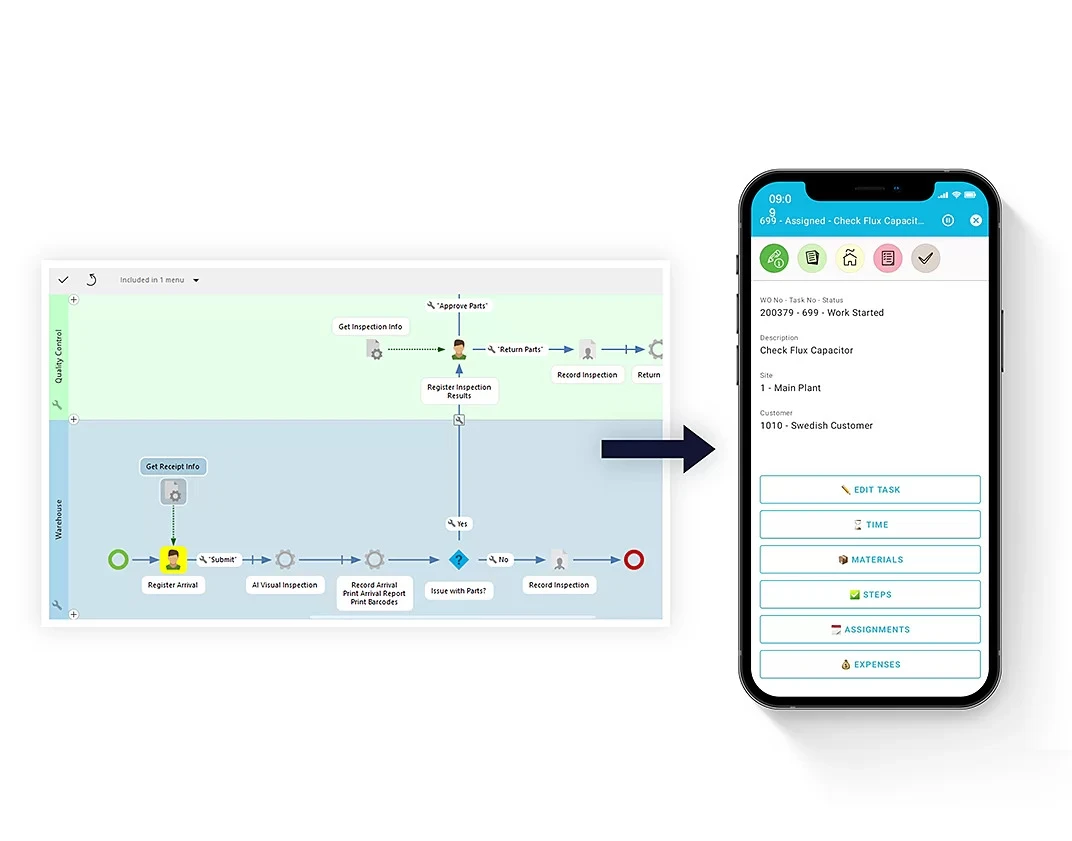
Then, wrap a flexible, intelligent workflow layer around the whole ecosystem. This layer doesn't replace your core investments; it connects them in a way that mirrors how people actually work. It manages the handoffs, the approvals, the notifications, and the exceptions across all your different platforms.
It turns a series of disconnected tasks into a single, fluid process. The goal is to let your team focus on the work that matters, not on the logistics of moving information between the tools that are supposed to help them. That's where you'll find your next big leap in productivity.