Manufacturers invest heavily in ERP, WMS, MES, and CRM, yet productivity suffers in the hand-offs between systems. Discover the hidden costs and how to fix them.
Manufacturers have poured serious money into ERP, warehouse, production, quality, transport, and customer management systems. Each platform does its job well. Yet employees still waste hours shuffling information between applications, waiting for approvals, or patching gaps with spreadsheets and email.
In many cases, the next productivity challenge isn't inside the individual applications. It's in the hand-offs between them.
### When Good Systems Still Create Inefficient Work
A modern manufacturing business might rely on ERP for orders and inventory, WMS for warehouse execution, MES for production, CRM for customer info, and specialist apps for transport, quality, or maintenance.
On their own, these systems deliver accurate data and powerful features. The trouble starts when a process crosses several of them. An employee gets info in one app, does part of a task in another, then manually pings someone in a third department. Data gets re-entered, approvals depend on email, and supervisors bounce between systems to figure out if work can continue.
The organization is digital, but the process is still fragmented. That distinction matters because employees don't experience systems in isolation—they experience complete workflows. If moving from one step to the next requires manual intervention, productivity suffers even when every platform works perfectly.
### The Hidden Cost of Handoffs
These inefficiencies are easy to overlook because each one seems tiny. Copying a reference number takes seconds. Sending a confirmation email takes a few more. Switching systems to check stock or delivery status feels like part of the job.
But across hundreds of transactions and multiple departments, those small hand-offs add up. They also introduce operational risks:
- Information entered differently in two systems
- Approvals sitting unnoticed in an inbox
- Warehouse staff working from outdated ERP data
- Teams waiting for confirmation that's already recorded elsewhere
> "The data moved. The process did not." — that's the heart of the problem.
The result is hidden operational friction that a conventional system review won't catch. Nothing is broken. The process just demands more human effort than it should.
### Why Integration Alone Doesn't Solve the Problem
The obvious fix is to integrate systems, and modern APIs make data exchange easier than ever. But system integration and workflow integration are not the same thing.
Two apps can exchange data flawlessly while employees still have to decide what happens next. A production event might update the ERP, but an exception could still require someone to find the right manager, request approval, and manually relay the decision back to operations.
A connected workflow must account for people, business rules, and exceptions. It needs to determine who acts, what info they need, how the next step triggers, and what happens when the normal sequence breaks. That's why process orchestration is becoming a core part of enterprise tech strategies. The challenge isn't just getting systems to talk—it's getting work to flow smoothly across them.
### From Connected Systems to Connected Workflows
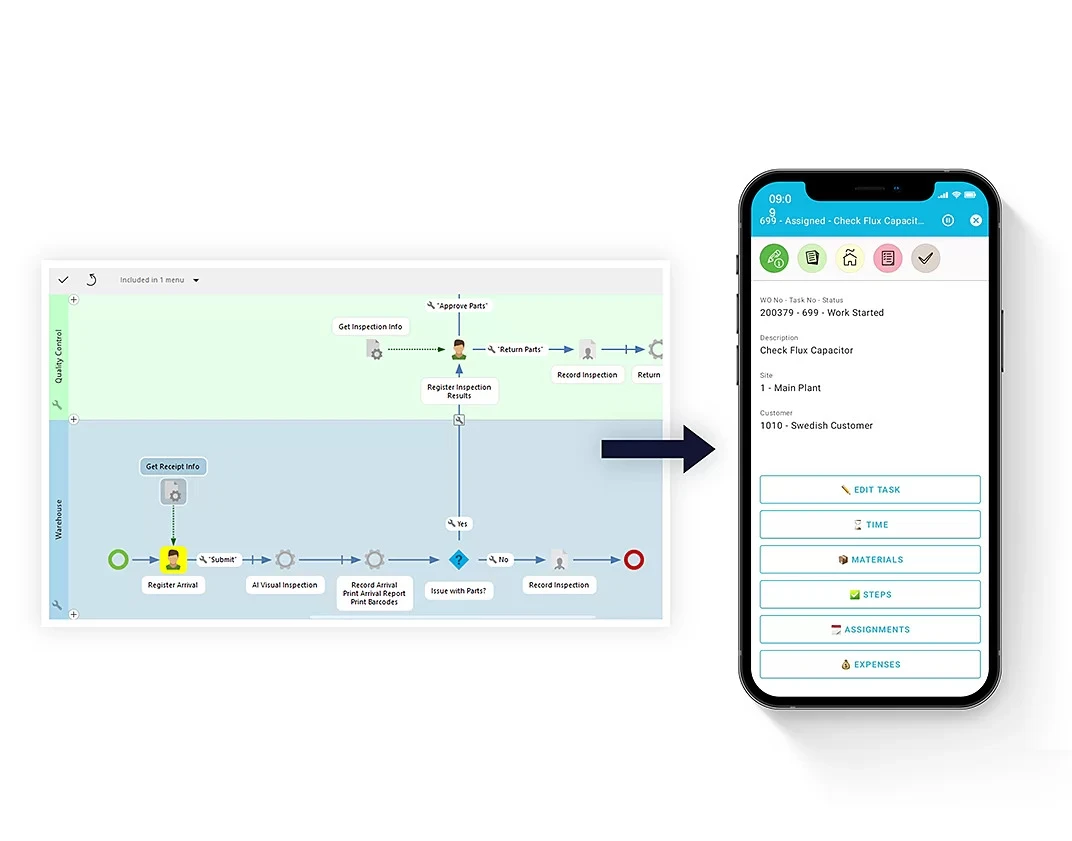
One approach is to keep core transactional systems stable while adding a flexible workflow layer around them. The ERP stays as the system of record for orders, inventory, and production. Specialist systems keep doing their thing. But a workflow layer orchestrates the hand-offs, automates approvals, and routes exceptions to the right person.
Think of it like a traffic controller for your business processes. Instead of employees manually directing traffic between systems, the workflow layer handles the routing. That frees people to focus on work that actually needs a human brain.
The productivity problem hiding between your business systems is real, but it's solvable. Start by mapping your critical workflows, identify the manual hand-offs, and then look for ways to automate or streamline them. You might be surprised how much time—and money—you're losing in the gaps.