Your ERP, WMS, and CRM work perfectly in isolation. But the real productivity killer is the manual work needed to move tasks *between* them. Discover the hidden cost of fragmented workflows and a smarter path forward.
Let's be honest. You've invested a ton—in ERP for your orders and inventory, a WMS for your warehouse, MES for production, and CRM for your customers. Each system does its job, and does it well. Yet, your team still spends their days copying data from one screen to another, chasing down approvals in email inboxes, and stitching everything together with spreadsheets.
It's frustrating, isn't it? The next big hurdle for productivity isn't inside any one of those shiny applications. It's hiding in the awkward, silent spaces *between* them.
### When Your Good Tech Still Feels Clunky
Think about a simple process, like fulfilling a custom order. It might start in your CRM, bounce to your ERP for inventory, ping the WMS for picking, and then need a quality check in another app. An employee is jumping between four or five windows just to get one thing out the door.
The data in each system is perfect. The *process* that connects them is a mess. It's digital, sure, but it's fragmented. And that's what your people experience every day—not isolated apps, but broken workflows.
### The Tiny Taps That Drain Your Tank
Here's the sneaky part. Each little handoff seems insignificant.
- Copying a PO number? Ten seconds.
- Emailing a supervisor for approval? Thirty seconds.
- Switching screens to check a shipping status? Another twenty.
But multiply that by hundreds of transactions across multiple teams, every single day. The cost adds up in lost hours, but also in something more dangerous: operational risk.
What if information gets keyed in differently between systems? What if that crucial approval email gets buried? Your warehouse could be working from stale data while another team sits idle, waiting for a confirmation that's already sitting in a different system.
Nothing is "broken" in a traditional sense. The process just needs more human glue than it should. It's hidden friction.
### Why Simply Connecting Apps Isn't the Answer
"Just integrate them!" is the obvious shout. And with modern APIs, moving data between Point A and Point B is easier than ever.
But here's the catch. Moving data isn't the same as moving *work*.
Two systems can talk flawlessly, but when an exception pops up—a part is out of spec, a shipment is delayed—your team still has to figure out who needs to know, how to get their approval, and how to tell everyone else. The data moved. The process stalled.
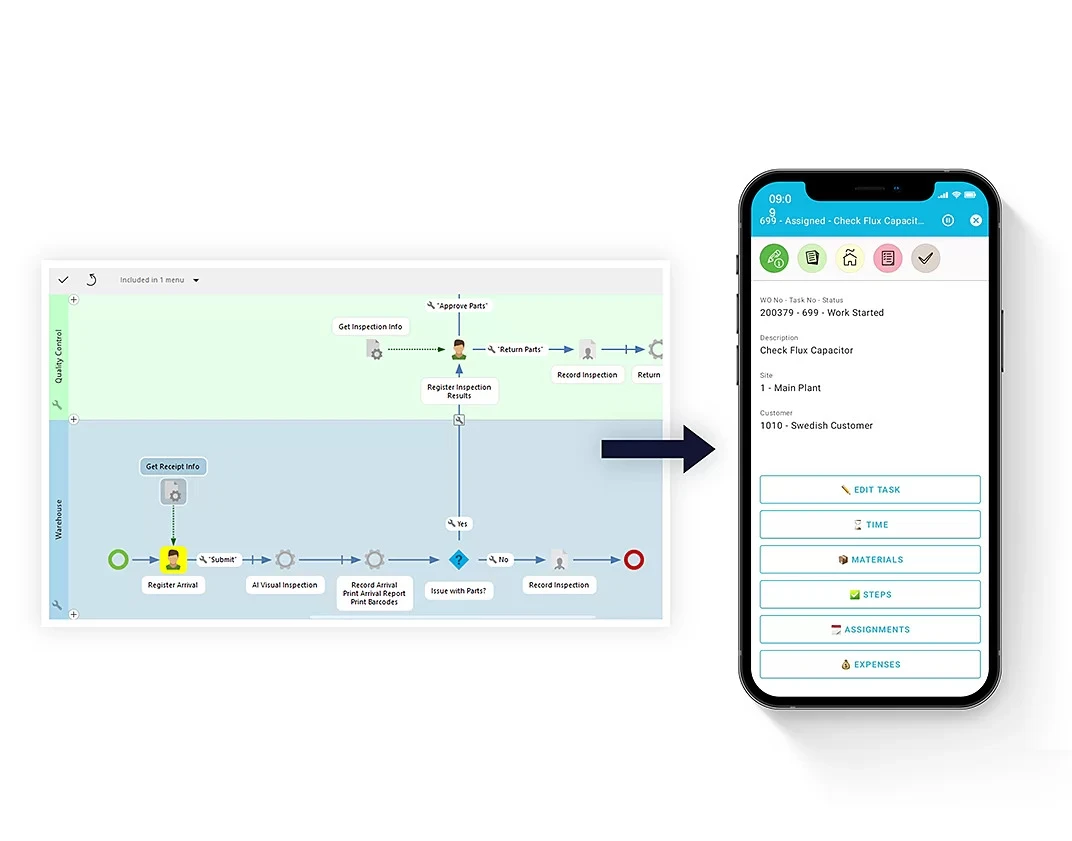
A truly connected workflow has to handle the people, the rules, and the "what ifs." It needs to know who acts next, what they need to see, and how to keep things moving when the plan goes off script.
That's why the conversation is shifting from system integration to **process orchestration**. The goal isn't just getting your software to chat. It's getting the actual *work* to flow smoothly from start to finish.
### From a Pile of Tools to a Cohesive Toolkit
So, what's a better path? Often, it's about leaving your core transactional systems—your ERP, your WMS—right where they are, doing what they do best. They're your systems of record.
Then, you wrap a flexible, intelligent workflow layer around them. This layer doesn't replace your big investments. It connects them in a way that makes sense for how people actually work.
It guides tasks to the right person at the right time, pulls information from all the right places, and automates the routine steps so your team can focus on the exceptions that truly need human judgment. It turns a series of separate actions into one coherent, efficient flow. That's where you find the next wave of productivity gains—not in a new system, but in the seams between the ones you already own.