For a growing manufacturing business, the machine on the shop floor is rarely just a line item on a balance sheet. It is a production commitment. When a laser cutter or CNC router goes down for two weeks because a spare part has to clear customs from the other side of the world, the cost is not the
When you're running a growing manufacturing business, that machine on your shop floor isn't just another item on a spreadsheet, is it? It's a huge commitment to your production. Think about it: if your laser cutter or CNC router goes down for a couple of weeks because a tiny spare part is stuck in customs halfway across the globe, the real cost isn't just that part. It's every single order you missed, every deadline you blew while your crucial machine sat there, doing absolutely nothing.
That's the big gap, the one between "the price on the quote" and "the true cost of ownership." It's where most folks make big mistakes when buying equipment. And as more and more small and mid-sized manufacturers across the UK and Europe upgrade their production lines, they're starting to ask a much smarter question. It's not just, "How much does it cost?" anymore. Now it's, "What happens when it breaks?"
### The Sneaky Risks in Industrial Procurement
Buying manufacturing equipment has always had this layer of risk that's just so easy to overlook when you're caught up in negotiations. Unlike buying some software or a new office chair, a laser cutting machine or a CNC router is a long-term asset. We're talking about something often financed over several years, expected to run day in and day out, and directly tied to how much money your company can actually make.
The risk isn't usually with the machine itself. Honestly, most industrial equipment out there today, no matter where it's made, is technically pretty solid. The real risk, the sneaky one, is in everything *around* the machine. It's about who actually checks its build quality before it even leaves the factory, who's on the hook if a component fails, and, most critically, how fast your business can get back up and running when something inevitably goes wrong.
This becomes super important for companies buying equipment made outside of Europe. The manufacturing capability might be there, no doubt. But trying to evaluate that from thousands of miles away, without any local backup if things go sideways, that's where a lot of buyers get burned. A machine that looks identical to a competitor's on paper can have a completely different risk profile once you peek past that initial price tag.
### Why Your Supplier Matters as Much as the Manufacturer
We're seeing a clear pattern emerge among small and medium-sized manufacturers: the businesses that have the fewest headaches with their procurement aren't usually the ones buying directly from some unknown factory overseas. Nope. They're the ones who buy through a trusted supplier, someone who acts as a bridge between the manufacturer and the customer.
This supplier has already done the heavy lifting – the due diligence on build quality, sourcing components from well-known industrial brands, and, crucially, they're reachable and accountable right there, locally, once the sale is done. It's not about being nationalistic in your sourcing; it's about smart risk transfer.
A good local or regional supplier takes on the burden of:
* Vetting manufacturers thoroughly.
* Stocking essential spare parts.
* Managing all those tricky warranty claims.
This way, you don't have to become an expert in international industrial sourcing just to keep your production line humming along. It lets you focus on what you do best.
Let's look at Virmer, a Dutch-based supplier that sells CO2 and fiber laser machines, CNC routers, and related gear across Europe. They're a great example of how this works. Instead of just reselling equipment from any factory, they work with a select, vetted group of manufacturers and component brands. They back their machines with a solid warranty, starting at two years, which you can extend up to five years on certain equipment. Plus, they offer local service and delivery across the EU. For a buyer, this setup does two things at once: it filters out a whole layer of manufacturing risk *before* the machine even gets to your shop floor, and it turns that abstract promise of "quality" into a concrete, time-bound commitment you can rely on.
### What a Truly Useful Warranty Looks Like
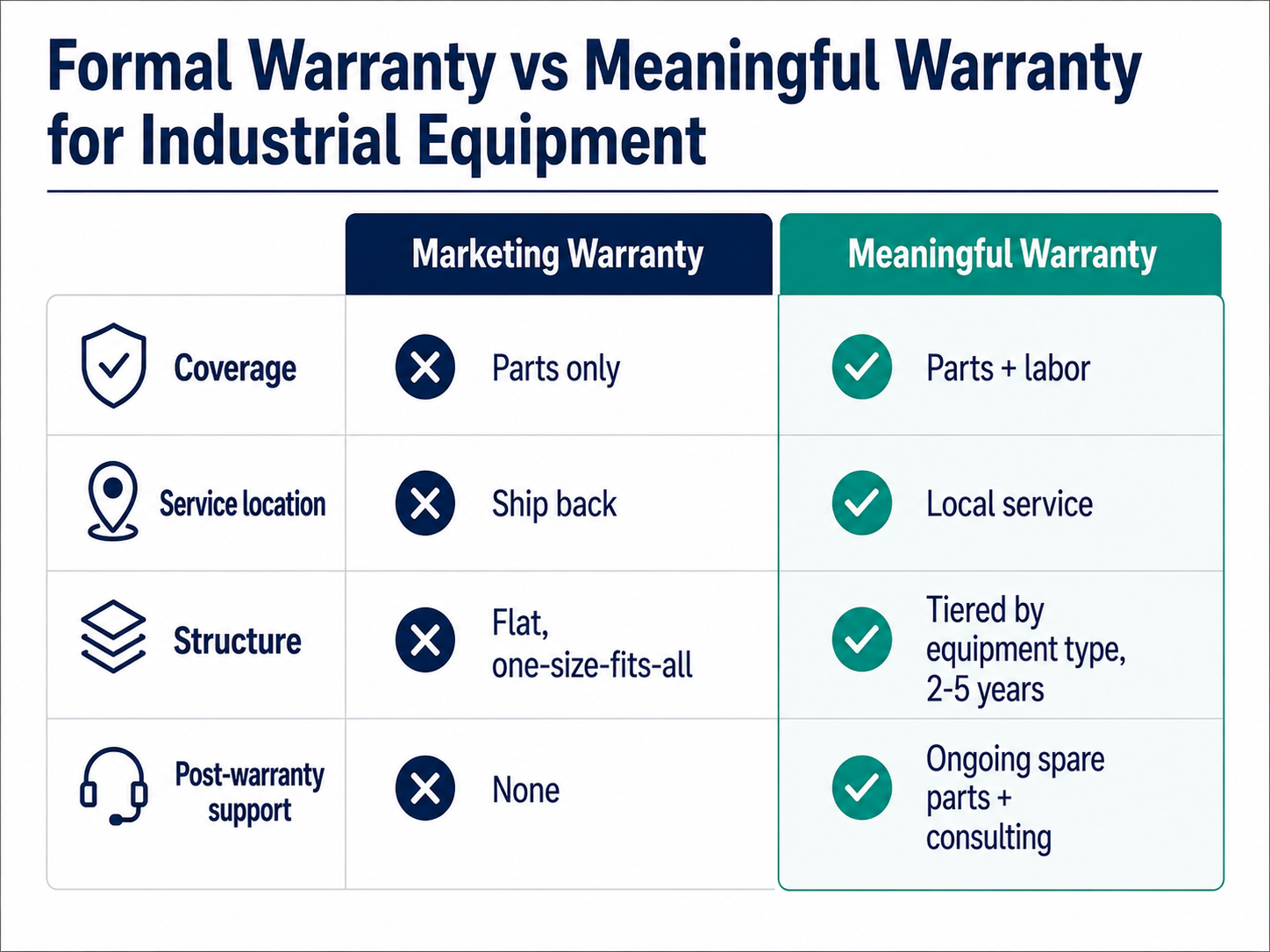
Here's the thing: not all warranties are created equal. Savvy manufacturing buyers are increasingly digging into the fine print instead of just taking the headline number at face value. There are a few key questions that really separate a meaningful warranty from just a marketing slogan:
* Does it cover parts, labor, or both? A warranty that only covers parts can still leave you with a hefty bill for a technician's time.
* What's the actual response time for service? Knowing you have a warranty is one thing; knowing someone will be there to fix it within 24-48 hours versus two weeks is another entirely.
* Are spare parts readily available locally, or do they have to come from overseas? This ties back to that initial customs delay nightmare.
* What constitutes a "defect" versus "wear and tear"? The clearer the terms, the better.
* Is the warranty transferable if you sell the machine? This can impact its resale value.
Asking these questions upfront can save you a ton of stress and unexpected costs down the road. It's all about understanding the full picture, not just the initial price.