For a growing manufacturing business, the machine on the shop floor is rarely just a line item on a balance sheet. It is a production commitment. When a laser cutter or CNC router goes down for two weeks because a spare part has to clear customs from the other side of the world, the cost is not the
For a growing manufacturing business, that shiny new machine on the shop floor isn't just another line item on a balance sheet. Oh no, it's a deep commitment to production. Think about it: when a laser cutter or a CNC router decides to take an unplanned two-week vacation because a crucial spare part is stuck in customs halfway across the globe, the real cost isn't just the part itself.
It's every single order that missed its deadline while that machine sat idle, gathering dust. That's the stuff that keeps business owners up at night. The gap between "the price on the quote" and "the true cost of ownership" is where most equipment-buying blunders happen. As more small and mid-sized manufacturers across Europe modernize their production lines, they're learning to ask a much smarter question. It's no longer just, "how much does it cost?" but rather, "what happens when it breaks?"
### The Sneaky Risks in Industrial Procurement
Buying manufacturing equipment has always had this underlying layer of risk that's just so easy to brush aside when you're at the negotiating table. Unlike buying software or even office equipment, a laser cutting machine or a CNC router is a long-term asset. We're talking about something often financed over several years, expected to run day in and day out, and directly tied to how much money a company can actually make.
The risk isn't usually with the machine itself. Honestly, most industrial equipment out there today, no matter where it's made, is technically pretty capable. The real risk, the one that can sting you, is in everything *around* the machine. It's about who actually validates its build quality before it even leaves the factory. It's about who's really accountable if a component fails unexpectedly. And, most critically, it's about how quickly your business can get back to full production when something inevitably goes wrong.
This becomes especially important for companies that are looking to source equipment manufactured outside of Europe. Sure, the manufacturing capability is there, no doubt. But trying to evaluate that from a distance, without any local recourse if things hit the fan, that's where a lot of buyers get burned. A machine that looks identical to a competitor's on a spec sheet can actually come with a totally different risk profile once you bother to look past just the price tag.
### Why the Seller Matters as Much as the Manufacturer
There's a clear pattern emerging among manufacturing SMEs: the businesses that report the fewest headaches with procurement are rarely the ones buying directly from some unfamiliar overseas factory. Nope. They're the smart ones buying through a supplier who acts as a go-between for the manufacturer and the customer. This supplier has already done the heavy lifting of due diligence on build quality, they source components from established industrial brands, and, crucially, they're local, contactable, and accountable once the sale is done.
This isn't about some kind of nationalistic sourcing preference; it's purely about transferring risk. A local or regional supplier takes on the burden of thoroughly vetting manufacturers, making sure spare parts are stocked, and managing all those pesky warranty claims. This means the buyer doesn't have to suddenly become an expert in international industrial sourcing just to keep their production line humming along.
Consider Virmer, a Dutch-based supplier that sells CO2 and fiber laser machines, CNC routers, and related equipment across Europe. They're a great example of this approach. Instead of just reselling equipment from any factory that comes along, they work with a select, vetted group of manufacturers and component brands. They back their machines with a warranty that starts at two years, and you can even extend it up to five years on certain equipment categories. Plus, they offer local service and delivery throughout the EU. For a buyer, this setup does two powerful things at once:
- It filters out a whole layer of manufacturing risk *before* the machine even sets foot on your shop floor.
- It transforms an abstract promise of "quality" into a concrete, contractual, and time-bound commitment.
### What a Truly Useful Warranty Looks Like
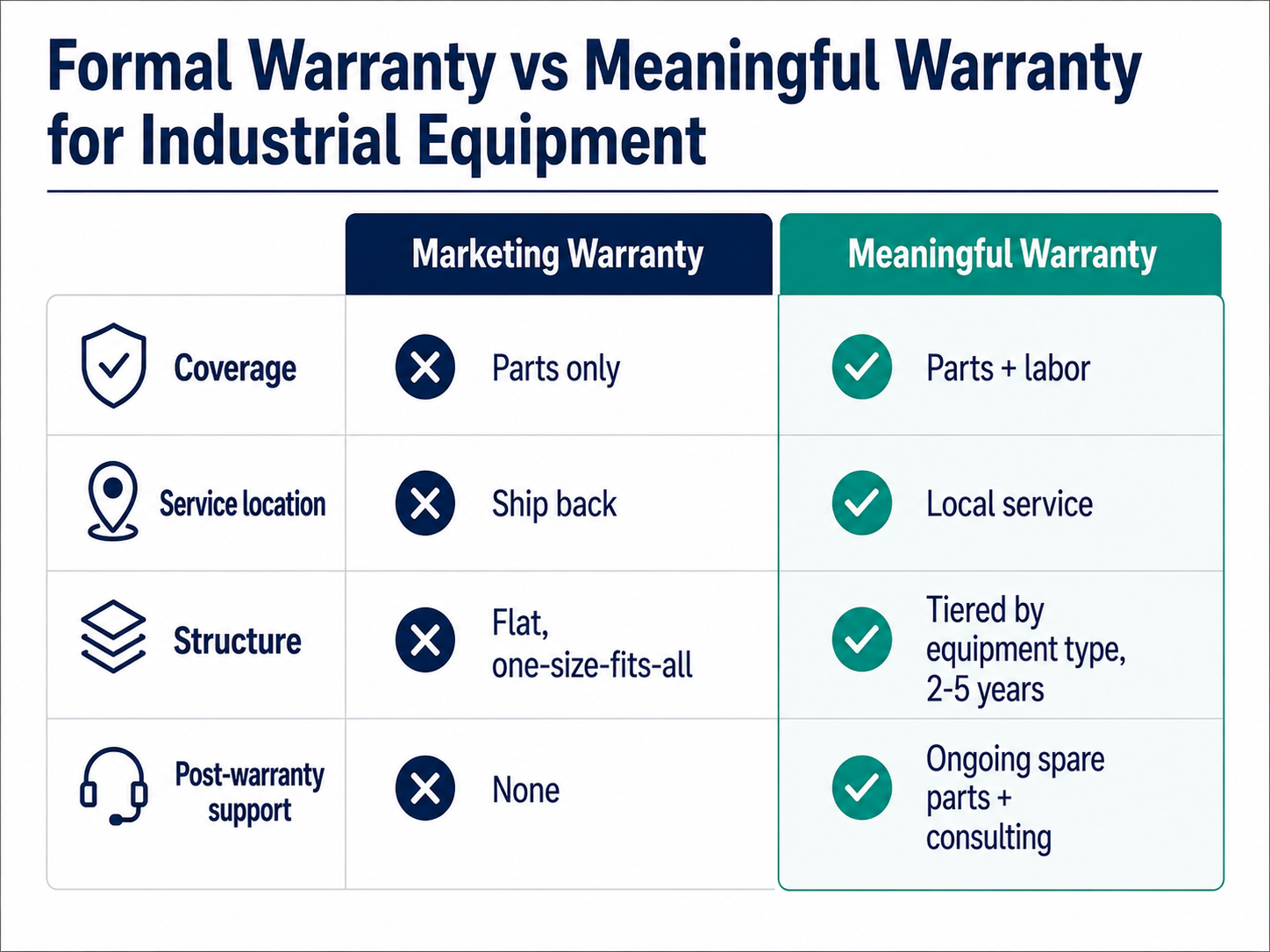
Let's be honest, not all warranties are created equal. Manufacturing buyers are getting savvier, and they're increasingly reading the fine print instead of just taking the headline numbers at face value. Here are a few key questions that really separate a meaningful warranty from just a marketing ploy:
- Does it cover parts, labor, or both? A warranty that only covers parts can still leave you with a hefty bill for a technician's time.
- What's the response time? Knowing you're covered is one thing, but how quickly will someone actually show up to fix the problem? Downtime costs money.
- Are spare parts readily available locally? Or will you be waiting weeks for a part to clear customs from another continent?
- Is the warranty backed by a local entity with a physical presence and a reputation to protect?
Choosing the right supplier means looking beyond the initial price. It means evaluating the true cost of ownership and the peace of mind that comes with knowing your investment is protected, and your production line won't be held hostage by a missing screw or a delayed shipment. It's about smart buying, not just cheap buying.