Industrial equipment purchases carry hidden risks beyond the price tag. Learn why the supplier's accountability and warranty details matter more than the machine's spec sheet.
For a growing manufacturing business, the machine on the shop floor is rarely just a line item on a balance sheet. It's a production commitment. When a laser cutter or CNC router goes down for two weeks because a spare part has to clear customs from the other side of the world, the cost isn't the part. It's every order that missed its deadline while the machine sat idle.
That gap between the price on the quote and the true cost of ownership is where most equipment-buying mistakes happen. As more small and mid-sized manufacturers across the UK and Europe modernize their production lines, the smart ones are no longer asking just "how much does it cost?" They're asking "what happens when it breaks?"
### The Hidden Risk in Industrial Procurement
Manufacturing equipment purchases have always carried a layer of risk that's easy to underestimate at the negotiating table. Unlike software or office equipment, a laser cutting machine or a CNC router is a long-term production asset. It's often financed over several years, expected to run daily, and directly tied to your company's revenue capacity.
The risk isn't necessarily in the machine itself. Most industrial equipment on the market today, regardless of country of origin, is technically capable. The risk sits in everything around the machine: who validates its build quality before it ships, who's accountable if a component fails, and how quickly you can get back to production when something goes wrong.
This is especially relevant for companies sourcing equipment manufactured outside Europe. The manufacturing capability exists, but evaluating it from a distance without local recourse if something goes wrong is where many buyers get burned. A machine that looks identical to a competitor's on a spec sheet can carry a completely different risk profile once you look past the price tag.
### Why "Who Sold It To You" Matters As Much As "Who Made It"
Here's a pattern that's become increasingly visible among manufacturing SMEs: the businesses reporting the fewest procurement headaches are rarely those buying directly from an unfamiliar overseas factory. They're the ones buying through a supplier that sits between the manufacturer and the customer. Someone who has already done the due diligence on build quality, sources components from established industrial brands, and, critically, is contactable and accountable locally once the sale is closed.
This isn't about nationalism in sourcing. It's about risk transfer. A local or regional supplier absorbs the burden of vetting manufacturers, stocking spare parts, and managing warranty claims. That way, you don't have to become an expert in international industrial sourcing just to keep your production line running.
Dutch-based supplier Virmer, which sells CO2 and fiber laser machines, CNC routers, and related equipment across Europe, illustrates how this plays out in practice. Rather than reselling equipment from any available factory, the company works with a limited set of vetted manufacturers and component brands. It backs its machines with a warranty starting at two years, extendable up to five years on select equipment categories, alongside local service and delivery across the EU. For a buyer, that structure does two things at once: it filters out a layer of manufacturing risk before the machine ever reaches the shop floor, and it converts an abstract promise of "quality" into a contractual, time-bound commitment.
### What a Genuinely Useful Warranty Looks Like
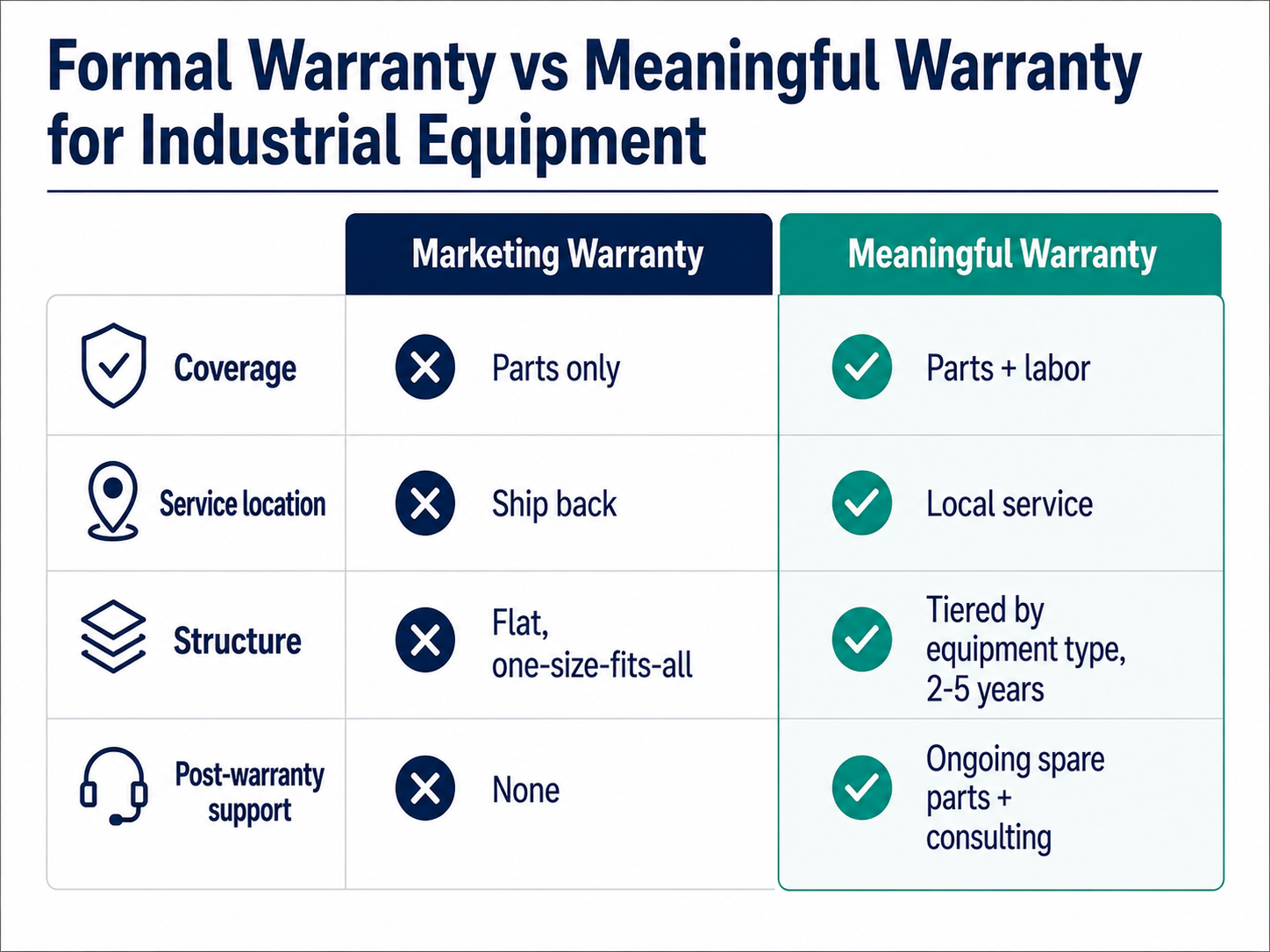
Not all warranties are created equal. Manufacturing buyers are increasingly reading the fine print rather than taking the headline number at face value. A few questions consistently separate a meaningful warranty from a marketing line:
- Does it cover parts, labor, or both? A warranty that only covers parts can still leave you with a hefty service bill.
- What's the response time? A warranty that promises a fix "within a reasonable time" is worthless when your line is down.
- Who performs the repairs? Local technicians versus shipping the machine back to the factory can mean days versus weeks of downtime.
- What's excluded? Wear items, consumables, and misuse clauses can gut the coverage you thought you had.
The real test is simple: would this warranty actually get you back to production quickly if something failed? If the answer requires reading three pages of exclusions, it's probably not the safety net you need.
### The Bottom Line
The true cost of industrial equipment isn't the purchase price. It's the total cost of ownership, including downtime, repairs, and the headaches in between. By focusing on who's accountable after the sale and what the warranty actually covers, you can de-risk your next purchase and keep your production line running. That's the difference between buying a machine and buying peace of mind.