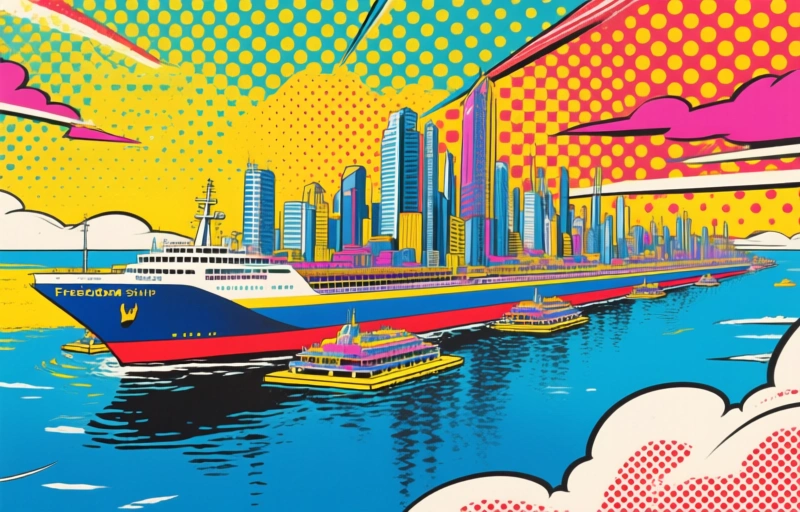
Explore the concept of Freedom Ship, a mile-long floating city for 80,000 people, and what it means for the future of property markets and EU startup incorporation.
Imagine a city that floats on water, stretching a mile long, with homes, businesses, and parks for 80,000 people. That's the vision behind Freedom Ship, a project that's been talked about for years but still feels like science fiction. For professionals in the EU startup scene, this isn't just a wild idea—it could hint at new ways to think about property, community, and even how you incorporate a business in Europe.
### What Is Freedom Ship?
Freedom Ship is a proposed floating city, designed to be a self-contained community on the ocean. It's not a cruise ship or a barge; it's a mile-long structure that would house everything you'd find in a small city: homes, offices, schools, hospitals, and shopping centers. The idea is to create a place where people can live, work, and play without being tied to any single country. Think of it as a sovereign city-state on water.
### Why Should EU Startup Professionals Care?
You might be wondering, "What does a floating city have to do with my startup?" Well, it's all about innovation and thinking outside the box. The EU Inc proposal, which aims to simplify cross-border business incorporation in Europe, shares a similar spirit. Both ideas challenge traditional boundaries—one for property, the other for business. If Freedom Ship ever becomes real, it could offer a unique location for startups that want to operate globally, with minimal bureaucracy. Imagine incorporating your EU company on a floating city, free from the red tape of any single nation.
### The Property Market Angle
Freedom Ship would be an extreme property market, with prices likely in the millions for a basic apartment. But for investors, it's a gamble. The project has been in development for decades, and there's no clear timeline for completion. Still, it sparks a conversation about how we value real estate in unconventional spaces. For US-based professionals eyeing European opportunities, this could be a reminder that property markets are evolving, and early adopters might find niche advantages.
### Challenges and Realities
Let's be real: building a mile-long floating city is incredibly hard. You're talking about engineering, legal, and financial hurdles that make starting a cross-border EU company look easy. The cost? Estimates run into the billions of dollars. And then there's the question of jurisdiction—where would you pay taxes? How would laws apply? These are the same kinds of questions the EU Inc proposal tries to answer for digital businesses. So, while Freedom Ship might be a pipe dream, it pushes us to think about flexibility in how we define "place" for business and living.
### What This Means for You
For EU startup professionals in the US, the lesson isn't to pack your bags for a floating city. It's about staying open to new models. The EU Inc proposal could make it easier to set up a company across borders, just like Freedom Ship could make property more fluid. Both ideas challenge the status quo. So, keep an eye on innovations like these—they might not happen tomorrow, but they shape the future of how we work and live.
- **Key takeaway:** Innovation in property and business incorporation often goes hand in hand.
- **Action step:** Explore how the EU Inc proposal could simplify your next venture.
- **Remember:** The future is about breaking boundaries, one idea at a time.
In the end, Freedom Ship is a bold concept that makes us dream. But for now, focus on the real opportunities in front of you, like leveraging EU Inc to grow your startup. Who knows? Maybe one day, your company will have an office on a floating city.