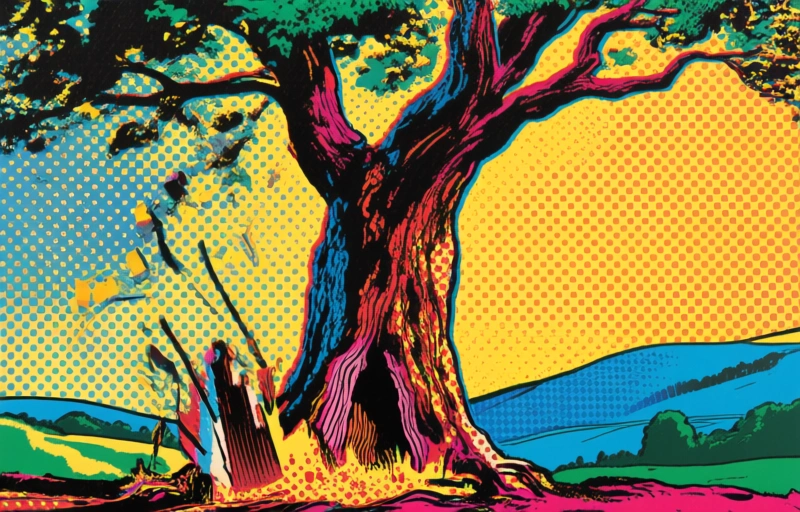
The Sycamore Gap tree was felled in 2023, but it's getting a second life. A national memorial will turn its 300-year-old rings into sound, letting the tree tell its own story through music.
You might have heard about the Sycamore Gap tree. It stood for centuries near Hadrian's Wall in Northern England, a lone figure in a dramatic dip in the landscape. Then, one night in 2023, someone cut it down. It felt like a punch to the gut for anyone who had ever seen it, walked past it, or just appreciated its quiet majesty. But now, there's a surprising twist. The tree is going to "speak" again.
### Turning Wood Into Sound
Here's the really wild part. A team of artists, scientists, and craftspeople are working on a national memorial. But this isn't going to be a statue or a plaque. They're taking the tree's actual rings—those annual growth layers that recorded every drought, every good year, every season of its life—and turning them into sound. Think of it like a vinyl record, but instead of music, it plays the tree's own history.
The process involves scanning the rings at a microscopic level. Each ring's width, density, and even chemical composition can be translated into a frequency. These frequencies are then composed into a piece of music or a soundscape. It's a way of letting the tree tell its own story, one that spans about 300 years.
### A Living Memorial, Not a Dead One
This approach feels more fitting than just leaving a stump or putting up a bronze plaque. The tree was a living thing, and this memorial keeps that spirit alive. It's not about mourning what was lost; it's about celebrating what it was. The sound installation will be housed somewhere near the original site, probably in a visitor center or a dedicated space where people can sit and listen.
- **The process:** Scientists map the tree rings digitally.
- **The translation:** Software converts ring data into sound waves.
- **The result:** A unique audio composition that changes as you listen.
What I love about this is how it makes you think differently about trees. We usually see them as silent, static objects. But they're actually recording devices. Every ring is a diary entry. This project just gives us the decoder.
### Why This Matters Beyond the UK
You might be thinking, "Okay, that's a cool art project, but why should I care?" Well, it's a powerful example of how we can use technology to connect with nature in a deeper way. It's also a reminder that even after destruction, something meaningful can be created. The tree is gone, but its voice isn't.
This isn't just about one tree. It's about how we remember things. We're so used to static memorials—granite, marble, bronze. But sound is different. It's temporal. It changes. You can't just glance at it and walk away. You have to sit, listen, and let it wash over you. That forces a kind of engagement that a plaque never could.
> "The tree will speak again, not with words, but with the music of its own life."
### What's Next for the Project
The team is still fundraising and working out the technical details. They're aiming to have the installation ready within the next couple of years. There's also talk of creating a digital version that people anywhere can access online. So even if you never make it to the UK, you might be able to listen to the Sycamore Gap tree from your living room.
It's a beautiful thought. A tree that stood for centuries in one spot, now able to travel the world through sound. It's not the same as seeing it in person, of course. But it's something. And in a world where we lose so many natural wonders, holding onto their voices feels like a small act of defiance.
So next time you walk past a big old tree, take a second. Think about what it's seen. What it's been through. And imagine, just for a moment, what it might say if it could speak. Thanks to this project, one tree finally will.