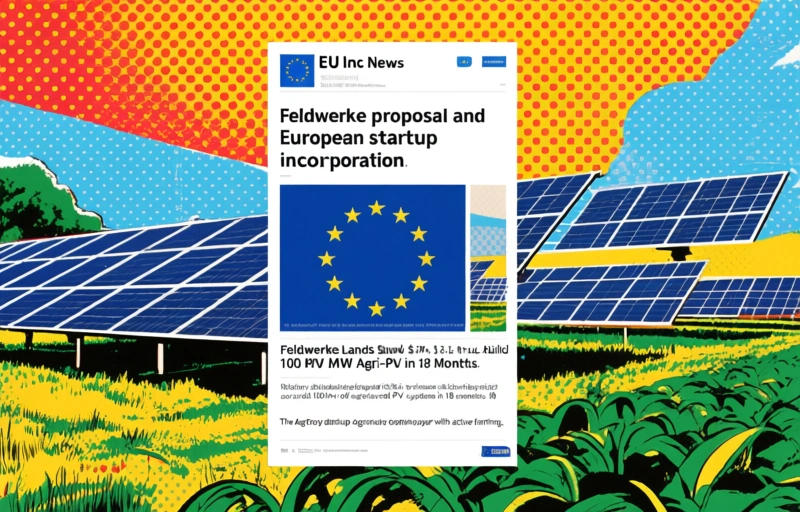
Feldwerke Lands $13.6M to Build 100 MW Agri-PV in 18 Months
Jan de Vries ·
Listen to this article~4 min
Munich-based Feldwerke secured $13.6M in revolving credit to build 100 MW of agri-PV systems in 18 months. The AgTech startup combines solar power with active farming.
Feldwerke, a Munich-based AgTech startup that develops and installs agri-PV (agrivoltaics) systems, just closed its first major debt financing round. A French debt fund specializing in renewable energy provided $13.6 million through a revolving credit facility. This money will help the company build out a construction portfolio of roughly 100 megawatts (MW) over the next 18 months.
### What This Financing Means for Feldwerke
“This financing marks a significant milestone for Feldwerke – and a clear signal that institutional investors have recognized the potential of agri-PV as a forward-looking form of land use,” said Nils Kuchenbuch, CEO of Feldwerke. “The revolving credit facility gives us the flexibility to execute our 100 MW portfolio swiftly and capital-efficiently.”
Founded in Munich in 2023 by Nicolai Reiners, Nils Kuchenbuch, and Marco Mielenz, the company has already installed over 20 MW of capacity in just two and a half years. That includes the largest agri-PV installation in southern Germany, located in Oberndorf am Lech.
The company says it combines sustainable energy generation with preserving agricultural land. It also actively involves local investors and municipalities in its projects.
### How Agri-PV Works
Feldwerke specializes in pairing solar power generation with active farming. In agri-PV setups, solar modules are mounted on tracking structures (trackers) above agricultural land. The ground beneath and between the rows stays available for growing grain or grazing livestock.
The company uses single-axis tracker systems that follow the sun’s path. This generates more energy overall and feeds disproportionately more power into the grid during the high-value morning and evening hours.
This concept is gaining traction with institutional investors, banks, and development finance institutions. They see the dual benefits of energy generation and land use as a strategic advantage over traditional open-field solar farms.
### The Power of Revolving Credit
The financing comes from a French debt fund that focuses on the construction and development phase of solar projects across Europe. They have deep experience structuring construction finance for growing developers.
Revolving credit facilities are powerful tools in infrastructure finance. Once a completed project is handed over to long-term project financing or connected to the grid, the credit line becomes available again for the next project. This allows Feldwerke to finance and execute multiple construction projects at the same time.
“We are very pleased to have found a partner who shares our long-term vision and accompanies us on this journey with the right financing structure,” Kuchenbuch added.
### What’s Next for Feldwerke
This flexible credit facility helps scale agri-PV project delivery. It brings Feldwerke closer to its goal of 1 gigawatt (GW) of installed capacity by 2030.
Right now, the company is developing around 50 projects totaling over 400 MW. The credit facility’s capital will be used solely for constructing agri-PV installations. About 100 MW of projects are in various stages, from final planning to active construction, and will be realized over the next 18 months.
The key benefits of this approach:
- Dual land use: farming continues beneath solar panels
- Higher energy output during peak demand hours
- Local community involvement in projects
- Scalable financing through revolving credit
It’s a smart model that could reshape how we think about renewable energy and agriculture together.