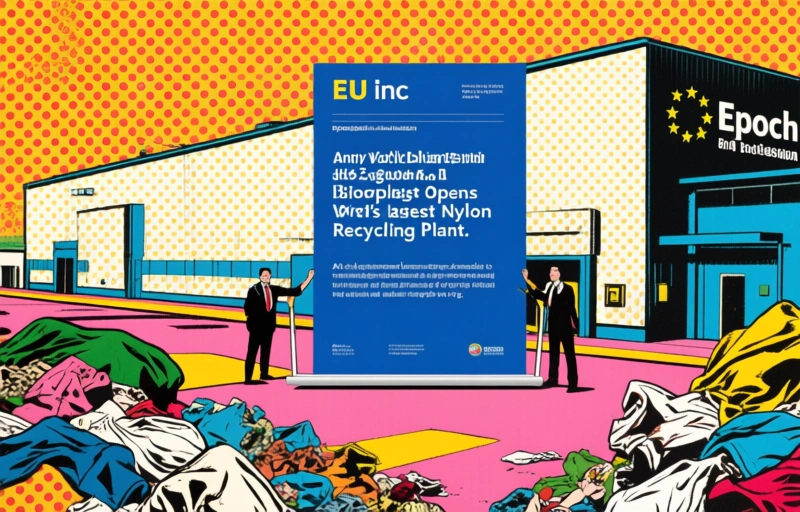
Epoch Biodesign opens the world's largest nylon 6,6 biorecycling plant in London. The facility uses AI-engineered enzymes to process hundreds of tons of waste annually, turning old clothes and industrial scraps into virgin-quality materials.
A British startup just took a huge step toward solving one of fashion and manufacturing's dirtiest problems. Epoch Biodesign, fresh off a $11.2 million funding round, announced it's building Europe's first and the world's largest nylon 6,6 biorecycling demonstration plant. It's located at Grapht Works, Imperial College London.
This isn't just another lab experiment. The facility will process hundreds of tons of post-consumer nylon waste every year. We're talking about old clothes, car airbags, and industrial scraps that usually end up in landfills or incinerators.
### Why This Matters for the Circular Economy
Most recycling requires enormous heat and heavy infrastructure. That's why factories are often built far from cities. Epoch's process flips that model completely.
Jacob Nathan, founder and CEO of Epoch Biodesign, puts it simply: "One of the most important advantages of our biological process is what it does not do. It does not require high temperatures. It does not demand the heavy industrial infrastructure that has historically meant manufacturing must be sited far from where people live and work."
The Grapht Works facility sits right in a London neighborhood. That's intentional. Nathan adds, "The fact that we can build and operate a nylon 6,6 recycling plant in Greater London is not incidental; it is a feature of the clean, low-energy process our team has developed. This is what genuinely circular, industrial biochemistry looks like."

### The Tech Behind the Magic
Epoch uses AI-engineered enzymes to break down nylon 6,6. These enzymes tackle tough feedstocks like silicon-coated airbag fabric and elastane-blended textiles. The process turns them back into their original chemical building blocks, called monomers. These monomers are virgin quality and can re-enter the supply chain without any performance loss.
The company combines AI with advanced synthetic biology to design these enzymes. It's a smart way to recycle mixed waste streams that traditional methods can't handle.

### A Wave of Circular Economy Funding
Epoch isn't alone in this space. Several other startups are raising big money to tackle waste. Here's a quick look at recent rounds:
- WeSort.AI in Würzburg raised $10.9 million for AI-based recovery of critical raw materials
- Uplift360 in Bristol raised $8.1 million to expand composite-waste recovery
- Octarine Bio in Copenhagen added $5.4 million for sustainable pigments
- Sparxell in Cambridge raised $4.6 million for plant-based color tech
- WtEnergy in Barcelona secured $10.9 million for energy recovery from waste
- Seprify in Fribourg raised $14.6 million for cellulose-based industrial ingredients
Together, these adjacent rounds total about $54.5 million. Include Epoch's own $11.2 million, and the visible 2026 total hits roughly $65.7 million.
The UK stands out here. Both Uplift360 and Sparxell are British, just like Epoch. This suggests the country is becoming a hub for circular materials innovation.
### Investor Confidence Is Growing
Epoch's Series A in March 2025 was $18.5 million, led by Extantia Capital. That same investor also backed Uplift360's February 2026 round. It shows a clear pattern: investors see real potential in circular manufacturing and materials infrastructure.
Luciano Caruso, Chief Commercial Officer at Epoch Biodesign, explains the market pull: "The Grapht Works plant has the capacity to process hundreds of tonnes of post-consumer nylon 6,6 waste a year: this is sourced from apparel and automotive products, as well as various industrial applications. New EU regulations require these industries to confront what they do with end-of-life nylon, and incineration or landfill are no longer acceptable answers."
### What This Means for US Businesses
American companies should pay attention. Similar regulations could come to the US soon. The technology works at scale, and it's already operating in a major city. If you're in fashion, automotive, or any industry using nylon 6,6, this is a solution worth watching.
Epoch Biodesign was founded in 2019 and has quickly become a global leader in enzymatic recycling. Their ultra-low emission process produces virgin-quality materials from waste. It's a real step toward a circular economy that doesn't rely on burning or burying our trash.