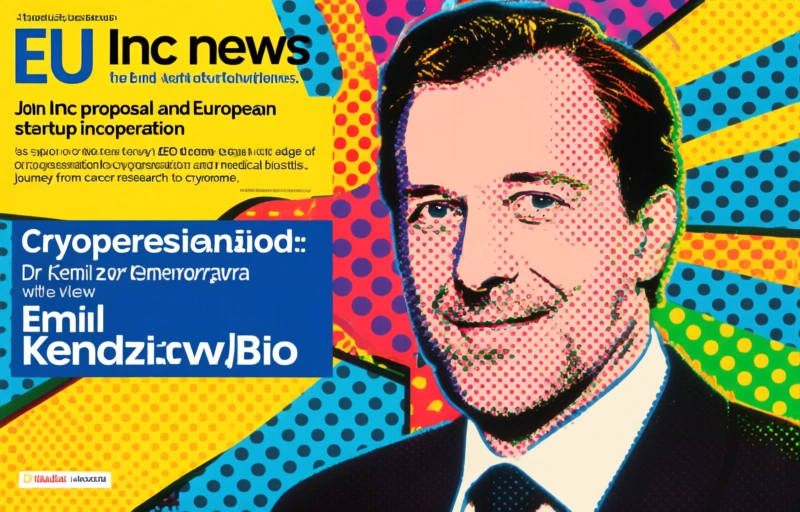
Cryopreservation Future: Emil Kendziorra Interview
Jan de Vries ·
Listen to this article~4 min
Join us for a deep-dive conversation with Dr Emil Kendziorra, CEO of Tomorrow.Bio, as we explore the cutting edge of cryopreservation and medical biostasis. Dr Kendziorra shares his journey from cancer research to cryomedicine.
Join us for a deep-dive conversation with Dr. Emil Kendziorra, CEO of Tomorrow.Bio, as we explore the cutting edge of cryopreservation and medical biostasis. Dr. Kendziorra, who began his career in cancer research with a summa cum laude degree from the University of Göttingen, shares his remarkable journey from academic science to entrepreneurship, and ultimately to founding Tomorrow.bio – a company he considers his life’s work.
### The Pivot from Cancer Research to Cryomedicine
Dr. Kendziorra didn't take a straight path to cryopreservation. He started in traditional longevity research, but something shifted. He realized that the biggest barrier to extending life wasn't just curing disease – it was time itself. That's when he dove into the frontier of cryomedicine. In this interview, he opens up about the operational and emotional lessons learned from cryopreserving over 20 human patients and 10 pets, and his vision for making this technology more accessible in the future.
> "I left behind a comfortable career in cancer research because I saw that cryopreservation could be the bridge to tomorrow's medicine."

### What Tomorrow.Bio Offers
Tomorrow.bio stands as Europe’s fastest-growing cryopreservation company, with over 800 members across 200+ cities and 45+ countries. The company offers both whole-body cryopreservation and brain-only preservation, using a transparent pricing model designed for long-term value. With a recent $5.5 million Seed round (converted from €5 million at current exchange rates) and a mission to advance medical biostasis, Emil discusses the unique challenges and opportunities of operating in this space.
### Key Insights from the Interview
- **The pivotal moment**: When Emil decided to dedicate his life to cryopreservation and biostasis, leaving behind a career in cancer research.
- **Why Europe needed this**: The necessity of a European-based cryopreservation organisation and what was missing before Tomorrow.bio entered the field.
- **How it works**: A detailed explanation of the cryopreservation process, from sign-up and stabilization to long-term storage in liquid nitrogen at temperatures below -320°F (-196°C).
- **Honest about limits**: Addressing the gap between preservation and revival, and the importance of honest communication with members about the current limitations.
- **Real-world lessons**: The operational and emotional lessons learned from cryopreserving the first 20 human patients and 10 pets.
### The Ethics of Waiting Decades
Emil doesn't sugarcoat it. This is a technology that may not achieve revival for decades, if ever. He discusses the ethical considerations of asking people to commit to something that might not pay off in their lifetime. But for him, it's about giving future generations a chance. He believes that if we can preserve the brain's structure today, future nanomedicine could theoretically repair and revive it.
### Why It Matters for U.S. Readers
While Tomorrow.Bio is based in Europe, the implications are global. The company's transparent pricing model and focus on accessibility could set a standard for the entire field. For U.S. professionals in longevity and biotech, this interview offers a rare look at how a European startup is tackling the same challenges that American companies face – but with a different regulatory and cultural approach.
This episode of the EU-Startups Podcast is brought to you by Vanta, the trust management platform that helps more than 12,000 companies start and scale their security programs. It saves security teams time and improves program visibility by automating over 35 compliance frameworks, such as SOC 2 and ISO 27001, as well as GRC workflows like risk management.