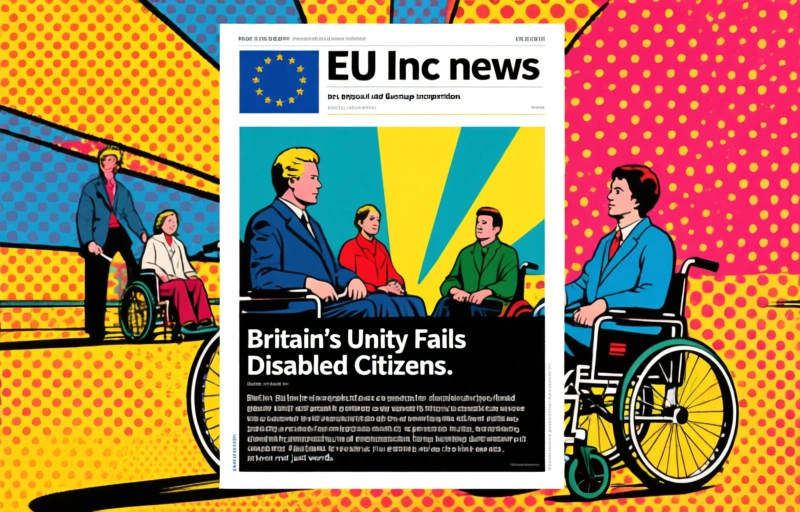
Disabled people in Britain face inaccessible systems, limited representation, and barriers to independent living. True unity requires action, not just words.
### The Reality of Inaccessibility
Millions of disabled people in Britain still face systems that just don't work for them. Think about it: a wheelchair user trying to navigate a city with broken curb cuts, or a blind person struggling with a government website that isn't screen-reader friendly. These aren't rare exceptions—they're everyday hurdles. And if you're not living it, you might not realize how deep the problem goes. In the United States, we talk a lot about the Americans with Disabilities Act, but across the pond, similar issues persist despite laws like the Equality Act of 2010.
### Barriers to Independent Living
Independent living shouldn't be a luxury, but for many disabled Britons, it feels that way. Here's what that looks like on the ground:
- **Transportation**: Trains and buses often lack proper access, with stations that have no elevators or ramps. A trip that takes 30 minutes for someone else can take hours of planning.
- **Housing**: Many homes aren't built with accessibility in mind. Doorways too narrow for a wheelchair, bathrooms that can't accommodate grab bars—it's a daily struggle.
- **Employment**: Job markets remain tough. Employers might not offer reasonable accommodations, and the unemployment rate for disabled people in the UK is roughly double that of non-disabled people.
These aren't just inconveniences. They're walls that keep people from living full lives. And when a country claims to be united, having these walls up is a contradiction.
### Limited Representation in Public Life
Here's a thought: when was the last time you saw a disabled person in a major TV ad or on a political debate stage? Representation matters because it shapes what we think is possible. In Britain, disabled voices are often sidelined in media and policy discussions. It's not just about being seen—it's about being heard. When decisions about healthcare, benefits, or infrastructure are made without input from those who rely on those systems most, the results fall short.
> "Nothing about us without us" is a core principle of the disability rights movement. But in practice, it's still a goal, not a reality.
### The Cost of Invisibility
Let's talk numbers. The UK government spends billions on disability benefits and support each year, but the return on that investment is often poor. Why? Because the system is reactive, not proactive. Instead of building accessible cities from the start, they patch problems after the fact. A study from the University of Cambridge found that inaccessible public transport costs the UK economy over $2.5 billion annually in lost productivity. That's money that could be reinvested into better infrastructure, but it's lost because people can't get to work.
### What Needs to Change
Change isn't impossible. It starts with listening and then acting. Here are three things that would make a real difference:
1. **Universal Design Standards**: New buildings, apps, and services should be designed for everyone from day one. It's cheaper in the long run and more inclusive.
2. **Better Data Collection**: We need to know where the gaps are. Right now, data on accessibility is spotty, making it hard to target solutions.
3. **Accountability**: If a city has a 10-year plan to fix sidewalks, there should be public checkpoints. No more empty promises.
### A Call for True Unity
Britain can't claim to be united while millions of its citizens feel invisible. This isn't about charity—it's about basic fairness. When we remove barriers, everyone benefits. A more accessible Britain would mean more people contributing to the economy, more diverse voices in leadership, and a society that actually lives up to its ideals. It's time to stop treating accessibility as an afterthought and start building a country where everyone belongs.
*This article was adapted from original reporting by The European Magazine.*