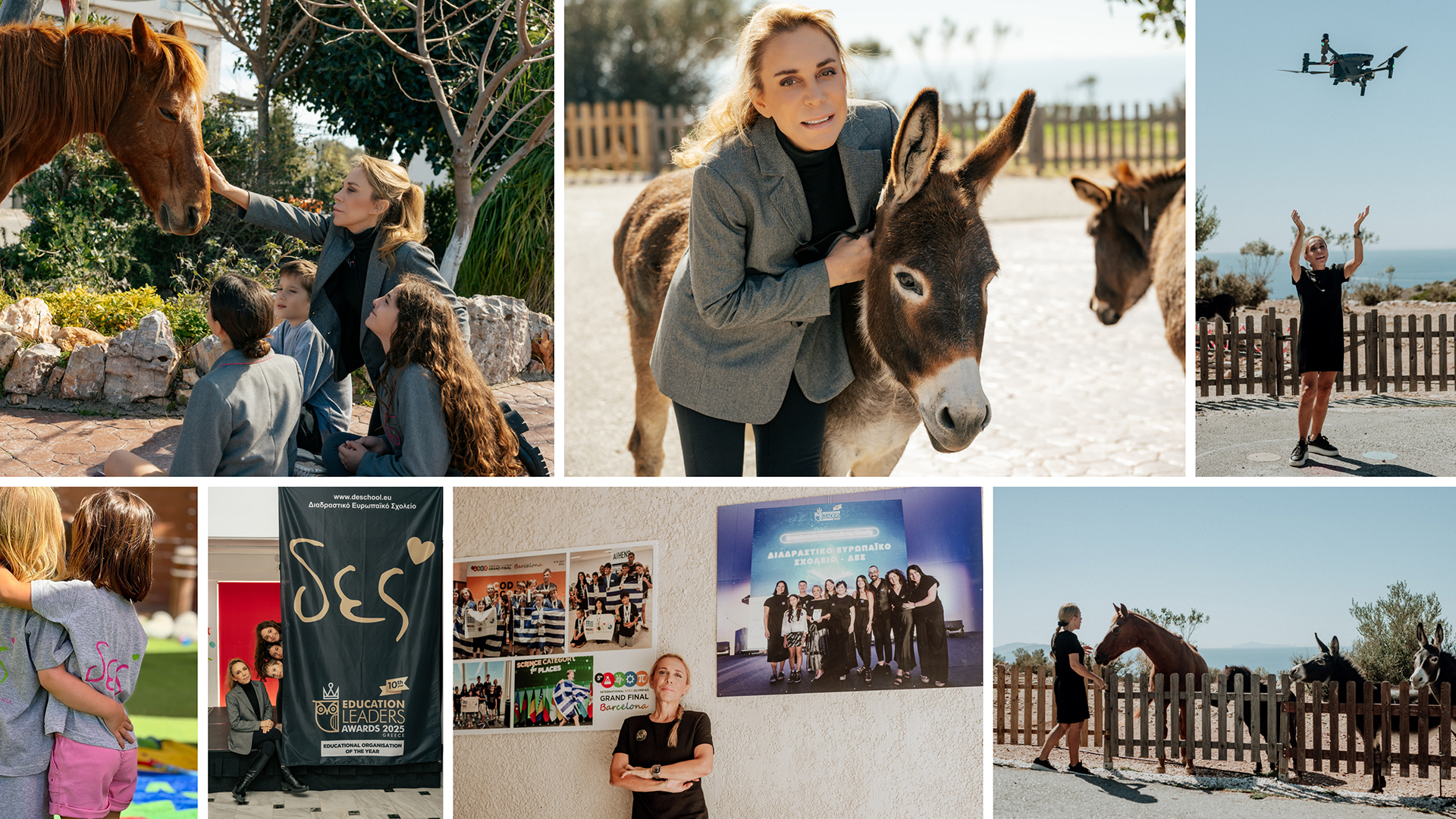
Discover how DES Interactive European School, named Best Bilingual IB School 2026 – Attica, blends the IB framework with Multiple Intelligences theory to create a truly unique learning experience.
### A Conversation with Dr. Billie Konstantara
What if a school could make learning feel like serious fun? That's exactly what DES Interactive European School is doing. Based in Varkiza, on the Athenian Riviera, this bilingual English-Greek school has been quietly reshaping what education can look like. It serves children from nursery through secondary school and has built a truly international community representing nearly 30 nationalities. After being named Best Bilingual IB School 2026 – Attica at this year's Hellenic Business Awards, we sat down with founder and CEO Dr. Billie Konstantara to learn more.
### The First of Its Kind
DES is the first bilingual school in Greece to combine the International Baccalaureate (IB) programmes with Howard Gardner's Theory of Multiple Intelligences. That means rigorous, inquiry-led, student-centred learning that's grounded in the Greek educational context but draws on international best practices. Right now, DES is authorized to offer the IB Primary Years Programme (PYP) and Middle Years Programme (MYP), with the Diploma Programme coming soon.
By blending the IB's academic rigor with Gardner's theory—which argues that people have multiple autonomous intelligences that interact to solve problems—DES creates an environment where every student is seen as distinct. And where everyone loves to learn.
> "At DES, innovation begins with a simple question: does this improve the way a child learns, belongs, or understands the world?" — Dr. Billie Konstantara
### More Than Just Classrooms
Today, the school spans four separate complexes in the southern suburbs. Across its nursery, kindergarten, primary, and middle school offerings, DES is home to about 450 students and 150 staff. Since the first location opened in 2004, the mission has always been to inspire young minds through a curriculum built around them and their growth. That's why all subjects are treated as primary subjects—whether it's sport, music, art, literature, languages, or math.
The campuses themselves are an invaluable part of the curriculum. Children learn across classrooms, gardens, and outdoor spaces, with animal interactions and other unique experiences that connect their knowledge with the natural world. Recognizing how diverse their future learning and careers will be, DES also integrates technology, robotics, creativity, and social responsibility into its learning ecology.
### Values That Go Beyond Results
Teaching at DES is guided by core values: intellectual curiosity, inclusion, responsibility, international-mindedness, and genuine care for the individual child. These reflect a school that cares about more than just test scores. Dr. Konstantara explains: "Our goal is not merely to prepare students for examinations. It is to develop knowledgeable, ethical, and emotionally secure young people who can think independently, collaborate across cultures, and contribute meaningfully to society."
Every staff member works to ensure each child is seen, understood, and appropriately challenged. They set high but achievable expectations, pair them with close observation, strong relationships, and differentiated teaching. As an international microschool on the Athenian Riviera, DES benefits from a small learning community—teachers really know their students and can respond quickly to their needs.
### Connections That Matter
Strong connections are also built across subjects, age groups, and cultures. For example, students might work on a project that combines science and art, or older students mentor younger ones. This approach fosters a sense of belonging and prepares students for a connected world.
In a time when education can feel like a race to the top, DES is a reminder that learning can be both serious and fun. And that's a lesson worth learning.