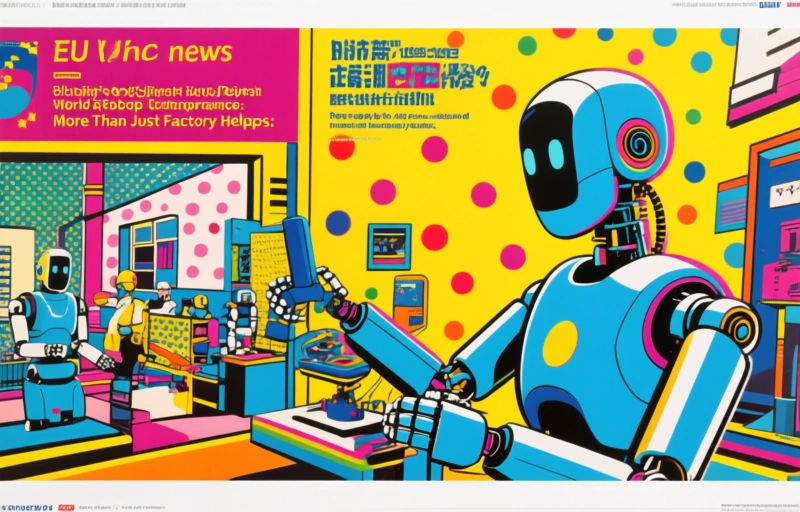
Beijing's World Robot Conference revealed a new wave of humanoid robots designed for homes and human interaction, not just factories. This shift signals a major step toward practical, everyday robotics.
So, you think robots are just for assembly lines? Think again. The recent World Robot Conference in Beijing showed something different, something that felt closer to science fiction becoming our daily reality.
It wasn't just about industrial arms welding car parts. This was about robots that could fold your laundry, play a decent game of table tennis, and maybe even keep you company. The shift from pure utility to something more... integrated into human life is happening faster than we expected.
### The Humanoid Helpers Stepping Out of the Factory
The biggest story wasn't the machines themselves, but what they're being asked to do. For years, the focus has been on precision and repetition in controlled environments. Now, developers are tackling the messy, unpredictable world of human homes and activities.
Imagine coming home to a robot that hasn't just vacuumed, but has sorted the kids' toys, started a load of laundry, and even prepped some vegetables for dinner. That's the domestic frontier they're pushing against. It's one thing to program a machine to spot a weld; it's entirely another to teach it to recognize a wrinkled shirt from a clean one.
### Where Play Meets Practical Application
What really caught my eye was the sport demonstration. Watching humanoid robots attempt athletic tasks isn't just for show. It's a brutal stress test for balance, spatial awareness, and real-time decision making. If a robot can track and return a ping-pong ball, the same technology can help it navigate a crowded room without bumping into furniture or people.
This crossover between 'play' and practical function is key. The algorithms that allow a robot to swing a tennis racket could, in theory, help it use a hammer or a wrench. They're building foundational skills that apply to countless scenarios.
Here’s a quick breakdown of the domains these new robots are entering:
- **Home & Care:** Laundry folding, basic cleaning, item retrieval, and even rudimentary companionship.
- **Skilled Tasks:** Moving beyond simple assembly to more complex repair and maintenance work.
- **Logistics & Delivery:** Navigating dynamic environments like warehouses or even last-mile delivery on sidewalks.
- **Interactive Services:** Roles in hospitality, retail, or customer-facing positions where interaction is needed.
It makes you wonder. We're not just outsourcing manual labor anymore. We're starting to delegate tasks that require a sliver of judgment, a touch of adaptability. That's a significant leap.
### The Unanswered Questions on Everyone's Mind
Of course, with every leap forward, a dozen new questions pop up. The tech is impressive, but the real-world application is a different beast. What's the price point for a household robot that can truly handle chores? Will it be a niche luxury or something accessible? How do we handle maintenance, software updates, and privacy when a robot with cameras and sensors is roaming your living room?
And then there's the human factor. It's one thing to see a demo in a controlled conference hall. It's another to have that technology operate reliably in the chaos of everyday life—with pets, kids, and all the unexpected hurdles a home presents.
"The goal is no longer to replace humans, but to create partners that can handle the tasks we find tedious, dangerous, or simply don't have time for," one developer noted. That's a subtle but important shift in the narrative.
The Beijing conference wasn't about announcing a finished product you can buy next week. It was a window into the next five to ten years. The building blocks are there. The engineering focus has expanded. The message was clear: the age of single-purpose industrial robots is giving way to the dawn of multi-capable, adaptive machines designed for human spaces. The real work—making them reliable, safe, and affordable—is what comes next.