Artemis II Toilet Fix: Astronauts Save Moon Mission
Jan de Vries ·
Listen to this article~4 min
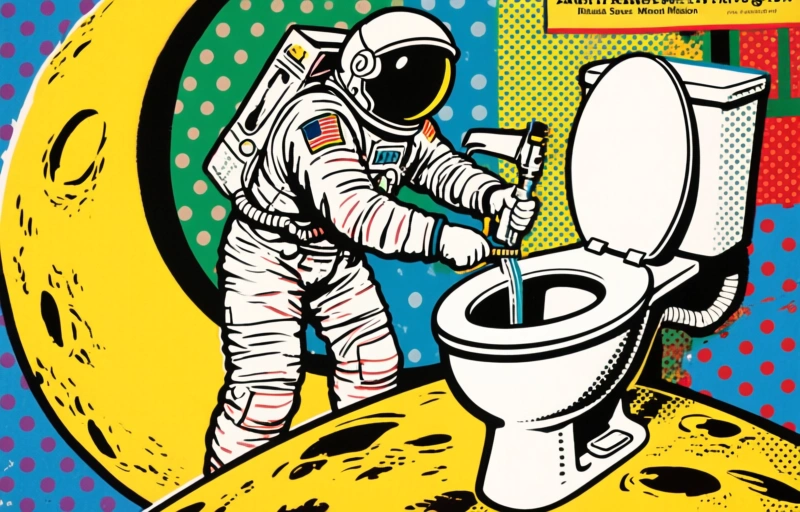
Artemis II astronauts quickly troubleshoot and repair Orion's toilet system after a warning light appears, demonstrating critical in-flight repair capabilities that keep the lunar mission on track.
You know that sinking feeling when something breaks at the worst possible moment? Imagine that happening 240,000 miles from Earth, with no hardware store in sight. That's exactly what the Artemis II crew faced when a fault light suddenly illuminated for Orion's toilet system.
We're not just talking about a minor inconvenience here. When you're hurtling toward the Moon in a spacecraft roughly the size of a small RV, every system matters. The waste management system—yes, that's the technical term for space toilets—is critical for crew health, comfort, and mission success.
### What Actually Went Wrong?
The details are still emerging, but here's what we know. During a routine systems check, astronauts noticed an unexpected warning light. It wasn't a full system failure, but in space, you don't ignore warning lights. The crew immediately began troubleshooting procedures they'd practiced countless times on Earth.
What's fascinating is how they approached the problem. There was no panic, no dramatic Hollywood moments. Just methodical, calm professionalism. They worked through checklists, consulted with ground control, and applied the training that's taken years to perfect.
- First, they isolated the affected subsystem
- Next, they ran diagnostic tests to pinpoint the issue
- Then they implemented a temporary workaround
- Finally, they restored full functionality
The whole process took just a few hours. That might seem quick, but in space terms, it's lightning fast. Every minute counts when you're on a trajectory to lunar orbit.

### Why Space Plumbing Matters More Than You Think
Let's be real for a second. We don't often think about space toilets until something goes wrong. But these systems are engineering marvels. In microgravity, nothing behaves as it does on Earth. Fluids don't flow downward—they float. Solid waste doesn't drop—it hovers.
Modern space toilets use suction systems to manage this challenge. They're compact, efficient, and absolutely essential. A failure isn't just uncomfortable—it could compromise the entire mission if not addressed promptly.
As one engineer put it during a briefing, "In space, there are no small problems. Only problems that haven't become big yet."
### The Bigger Picture for Artemis
This incident, while quickly resolved, highlights something important about the Artemis program. We're returning to the Moon after decades, and every mission teaches us something new. The fact that the crew could diagnose and fix this issue themselves speaks volumes about their training and the spacecraft's design.
Orion is built with redundancy and repairability in mind. Unlike earlier spacecraft where astronauts were mostly passengers, today's crews are true operators. They can troubleshoot, repair, and adapt as needed. That capability will be crucial when we eventually send humans to Mars, where help from Earth will be minutes or hours away.
What's next for Artemis II? The mission continues on schedule, with the crew now even more confident in their ability to handle unexpected challenges. They've proven that when problems arise—even bathroom-related ones—they've got the skills to keep moving forward.
Sometimes the most dramatic moments in space exploration aren't about explosions or near-disasters. They're about competent professionals quietly solving problems that could have derailed everything. That's exactly what happened here, and it's why we can feel confident about humanity's return to the Moon.