AI in 2026: Data Drought, Healthcare Innovation & Space Tech
Jan de Vries ·
Listen to this article~5 min
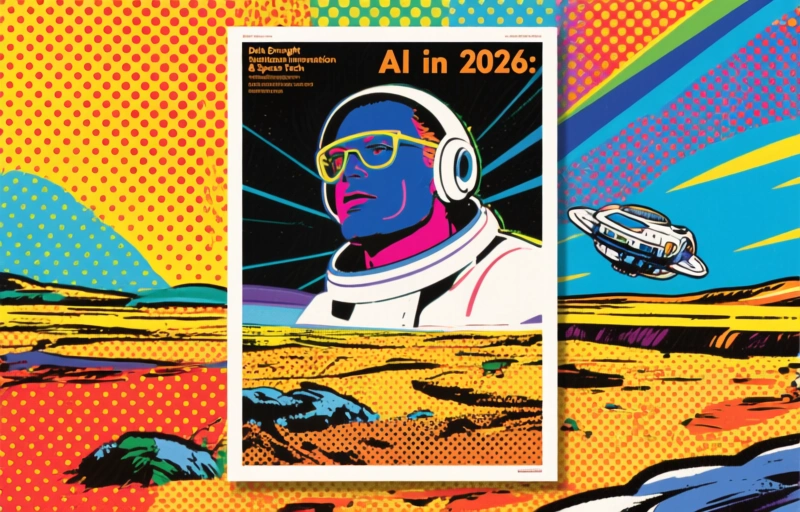
Beyond the AI hype, 2026 will be defined by a data drought, a healthcare revolution powered by wearables and AI, and new frontiers in space technology. These converging trends will reshape industries.
You know, looking back at the last year, it's been wild watching AI explode. Everyone's talking about those crazy valuations, but honestly, I'm more fascinated by what's coming next. The real story isn't just about the tech itself—it's about the data that feeds it, the lives it can change in healthcare, and how it might even help us reach for the stars. Let's break it down.
### The Looming AI Data Drought
Here's the thing nobody wants to admit: we're running out of easy data. The internet's been scraped clean by the big language models. So what happens next? Access to unique, high-quality data is about to become the biggest bottleneck—and the biggest opportunity—in AI.
Startups are going to have to get creative. I mean, really creative. We're talking about sourcing, generating, and owning training data in ways we haven't seen before.
- Synthetic data created by AI itself
- Proprietary operational data from businesses
- Data from new, interactive user experiences
This scarcity is actually creating a whole new market. Think about it: data marketplaces and brokers for AI solutions. Companies sitting on siloed information can suddenly monetize it. But there's a catch.
We're starting to see the risks of synthetic data. There's this concept called 'model collapse'—when AI starts learning from its own hallucinations, and the output just gets weirder and less accurate. Better, more accurate data sources are the only fix.
"The internet is just a tiny slice of the world's information," as one expert put it recently. Most valuable data is locked away—proprietary IP, unstructured offline records. The big question for 2026? How do we access that data safely, especially in sensitive fields like healthcare where security is everything.
I'm betting we'll see massive growth in this space over the next 12-18 months. Everyone wants a defensible data moat, and new players are going to find clever ways to build them.
### Healthcare's Digital Revolution
Now, let's talk about something that actually touches people's lives: healthcare. Wearables, remote monitoring, AI decision support—they're not just gadgets anymore. They're redesigning how care gets delivered from the ground up.
We're moving toward decentralized pathways that focus on at-home diagnostics and long-term support. By 2026, a few key shifts will be impossible to ignore.
First, clinical care is leaving the building. Why keep patients in expensive facilities for monitoring when we can do it in their homes? It cuts costs dramatically without losing data quality. Digital tools are streamlining everything from first consultation to treatment, which means less disruption for patients and lower overhead for clinics.
Most importantly, it gives medical professionals their time back. They can focus on complex cases instead of routine monitoring.
Then there's personalization. AI isn't just collecting data anymore—it's providing real-time guidance. This creates a continuous care loop that doesn't need constant human babysitting. It scales what existing staff can do and actually helps patients stick to their treatment plans.
This isn't about adding more tech toys. It's a complete reimagining of the patient journey. We're building systems that are more resilient, accessible, and frankly, more human. The hospital-at-home model won't be an alternative soon; it'll be the standard.
### The Final Frontier: Space Tech
As we face tighter constraints on energy and materials here on Earth, space is becoming the next logical frontier for technological expansion. And AI is going to be the co-pilot.
Think about the challenges: communication delays measured in minutes, autonomous systems that must operate perfectly in hostile environments, and the sheer volume of data from telescopes and probes. AI can process that data in real-time, make split-second decisions, and manage complex life support and navigation systems without waiting for instructions from Houston.
It's not just about exploration either. AI could optimize satellite networks, manage space manufacturing, and even help design sustainable habitats. The companies that figure out how to apply AI to these cosmic problems will be building the infrastructure for humanity's next chapter.
The trajectory is clear across all three areas. Data is the new oil, healthcare is being rebuilt around the patient, and our future in space depends on intelligent systems. 2026 isn't about one breakthrough—it's about how these threads converge to reshape our world.